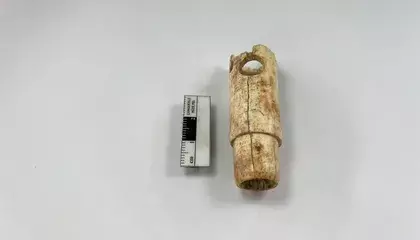
Archaeologists started excavating the ruins of Troy, the ancient city immortalized by the Greek poet Homer, in 1870. In the century and a half since, digs at the site in northwestern Turkey have unearthed a pair of gold diadems, more than 100 two-handled wine goblets, and arrowheads and weapons dated to the Late Bronze Age, among other artifacts. Now, researchers have added another intriguing object to the mix: a 2,800-year-old bone flute that is thought to be the first musical instrument ever discovered at Troy.
Turkey’s culture and tourism minister, Mehmet Nuri Ersoy, announced the find on social media last week, noting that the flute provides the first direct archaeological evidence of Troy’s musical culture. Although ancient texts and excavations elsewhere in Anatolia suggest that music “played an important role in [Trojan] religious rituals, as well as social and public life,” no physical traces of such performances had surfaced until now, the Hürriyet Daily News reports. Troya’nın binlerce yıllık kültür ve sanat tarihine iki yeni keşifle katkı sunuyoruz.
Bakanlığımızın izin ve destekleriyle Geleceğe Miras Projemiz kapsamında sürdürdüğümüz 2026 yılı kazılarında, yaklaşık 2.800 yıllık kemik flüt ile 4.500 yıllık insan biçimli bir idol başını gün ışığına çıkardık. Arkaik Dönem’e ait kemik flüt, 160 yılı aşkın Troya kazıları tarihinde bugüne kadar bulunan ilk ve tek müzik aleti. Bu keşifle, Troya’daki müzik kültürüne ilişkin doğrudan bir arkeolojik kanıta ulaştık.
Troya II kent kapısı çevresinde bulunan idol başıyla da Erken Tunç Çağı’nın sembolik dünyasını ve Batı Anadolu’daki kültürel etkileşimleri anlamamıza katkı sağlayacak yeni bir eseri günümüze kazandırdık. Troya’nın farklı dönemlerini belgeleyen bu buluntuları bilimsel yöntemlerle araştırarak korumaya ve gelecek kuşaklara aktarmaya devam edeceğiz. Kazı ekibimize, Kültür Varlıkları ve Müzeler Genel Müdürlüğümüzün ekiplerine ve çalışmalara katkı sunan tüm mesai arkadaşlarıma teşekkür ediyorum.
Experts discovered the flute in an archaeological layer dating to the eighth century B.C.E., around the time that Homer composed The Iliad and The Odyssey. (Troy’s ruins are divided into nine layers, each corresponding with a different era in the city’s history.) Scholars once thought that Troy was all but abandoned during this period, but more recent research has identified clear evidence of habitation in the area. As Rüstem Aslan, head of the excavation team at Troy, tells the state-run Anadolu Agency, the timing of the find is noteworthy: Earlier this year, composer Ludwig Göransson used a similar instrument to create the siren song featured in Christopher Nolan’s blockbuster film adaptation of The Odyssey. Played on a replica of an aulos, a double-reeded wind instrument popular in ancient Greece, the tune is one “of longing and sorrow that makes you share, briefly but profoundly, Odysseus’ feelings as he hears the sirens,” Joshua Barone wrote for the New York Times in July.
To find a flute that might date to Homer’s lifetime, in the same year that The Odyssey loomed so large in the popular imagination, “is an interesting coincidence from the perspective of excavation history,” Aslan says, per a translation by A News. In addition to the flute, archaeologists at Troy uncovered the 4,500-year-old head of an anthropomorphic figure that was likely used for religious or ritual purposes. The object was found near the city gate of Troy II, an Early Bronze Age settlement that was destroyed by fire around 2300 B.C.E.
Extract — continue reading at the source.