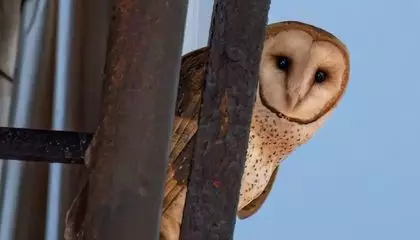
The newest celebrity family in New York City isn’t a group of Hollywood stars or musicians, but a posse of barn owls that have made a water tower in the Upper West Side their home. Since the animals’ arrival in the neighborhood, birders have been flocking to catch a glimpse of the nocturnal residents. Experts say that these barn owls are the first in modern history known to have nested in Manhattan—a welcome event given the species’ rapid population decline in New York over the past few decades.
It all began with a series of screeches in September, recalls resident Elisabeth Williams to Christopher Maag at the New York Times. For weeks, Williams and her husband heard the same sound from the patio of their apartment. Barn owls can look eerie, flying silently at night with their ghostly hues.
They might nest in barns and abandoned buildings, and their vocalizations don’t sound like typical hoots—they make raspy, shrieking calls. On October 3, Williams was finally able to snap a photo of the loud creature, confirming that it was a barn owl. It turned out that Scotty wasn’t flying solo.
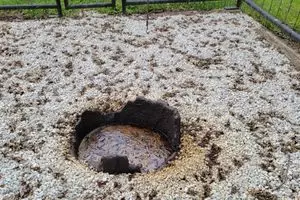
As many as eight barn owls—two adults and up to six juveniles—have now been spotted at a hole in a water tower, reports CBS News. The family’s arrival is great news, says Wilson to the Times. Barn owls are extremely rare sights in New York City, though there have been occasional sightings over the past few years.
The state is at the northern limit of the species’ range, and their habitat has decreased dramatically due to land development. To Paul Sweet, an ornithologist and collection manager at the American Museum of Natural History, the Upper West Side owls are an indicator that “some environments in New York City are becoming more raptor-friendly,” he says to Hell Gate. At the same time, birders and experts are worried that the owls are at risk of poisoning, because they feast on rodents.
But actually, what it does is kill the predators that feed on those rats,” Wilson tells CBS News. Post-mortem examinations revealed that he had a severe case of pigeon herpesvirus and had ingested four different types of rodenticide that likely contributed to his fatal crash. The city later passed “Flaco’s Law,” which includes a pilot program to curb rat populations using contraceptive methods rather than rodenticide.
Extract — continue reading at the source.