It’s one of gentlest caresses imaginable: the touch of a single atom of gas. Now, scientists have measured its impact. A levitating nanoparticle jiggled when hit by individual gas atoms or molecules in a nearly empty vacuum chamber, scientists report in the October 23 Physical Review Letters.
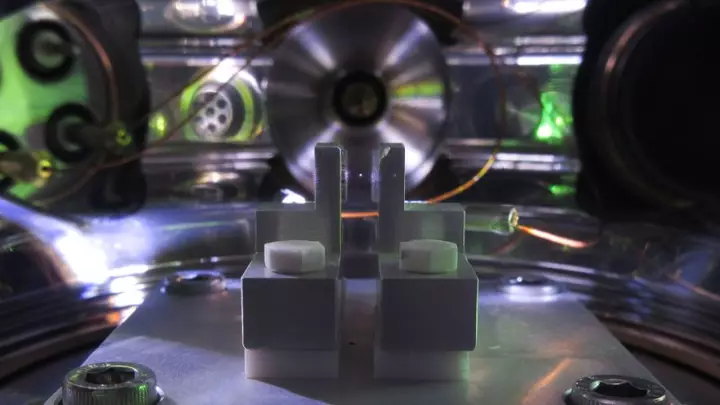
The force exerted by a gas is usually the result of many atoms or molecules bouncing around all at once: Think of the air inside a balloon keeping it inflated. But even an individual atom can exert a tiny force. To detect that force, researchers used a laser to levitate a glass sphere, just 100 nanometers across and weighing about a quadrillionth of a gram, inside a vacuum chamber.
Then, the researchers added small amounts of a heavy gas, either krypton, xenon or sulfur hexafluoride. The first two are gases made up of atoms, while the third consists of molecules. The nanosphere was about 10 million times as massive as an individual gas particle, making the impact extremely difficult to detect.
But, by monitoring the laser light that reflected from the sphere, the researchers could measure its tiny movements when hit by a gas particle. The resulting impulses were as small as a billionth of a Newton acting for one ten-trillionth of a second. And the rate of the collisions grew as the researchers introduced more gas into the chamber, increasing the pressure within.
That suggests a possible application for the technique. The system could also distinguish between the different types of gases Tseng and colleagues studied, as each one interacted differently with the nanoparticle. A device like this could help reveal the composition of particles in space, and even on other worlds, Tseng says.
Extract — continue reading at the source.