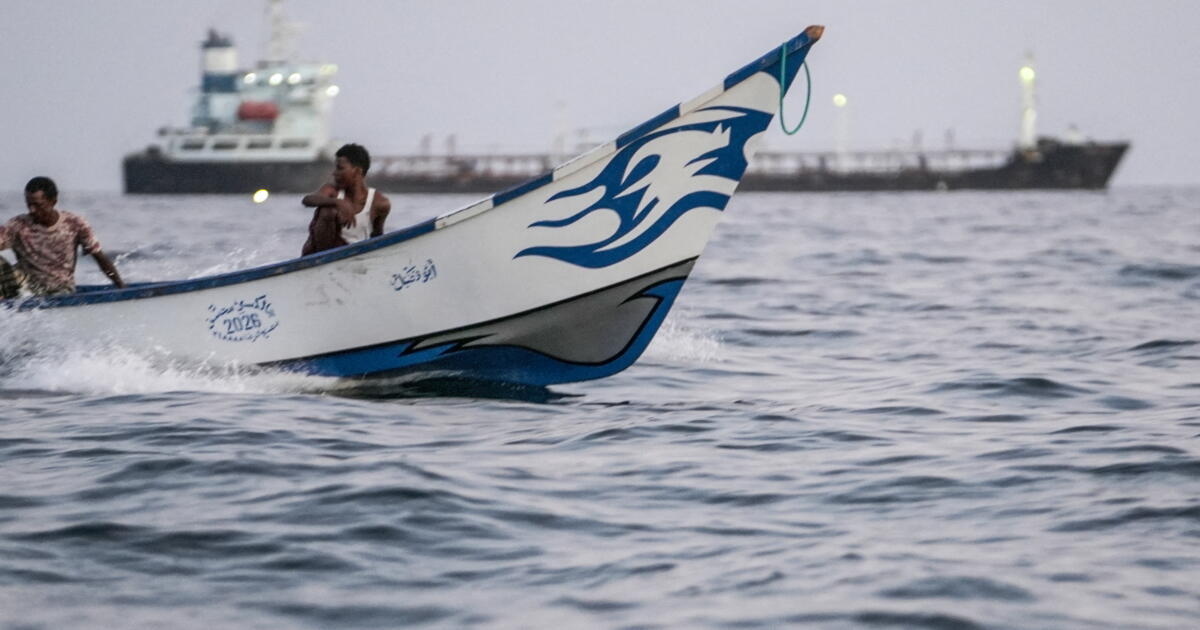
BAB EL-MANDEB, Yemen — To visit Bab el-Mandeb is to understand that old adage about looks being deceiving. For this humble fishing village in Yemen, a tumbledown grouping of barely-there huts nestled between the water and an imposing mountain range, stands sentinel over one of the world’s most vital waterways. The village shares its name with the Bab el-Mandeb Strait, the narrow passageway connecting the Red Sea with the Arabian Sea that’s become another flash point in the U.S.-Israeli war on Iran.
If the Yemeni government knew how to invest in it, we would be rich. We should be bringing in billions of dollars. Instead, look around you,” he said, pausing as his gaze took in the sorry-looking boats haphazardly laid on the beach.
Saleh was interviewed in January, when Bab el-Mandeb was thrust into the power struggle between Saudi Arabia and the United Arab Emirates, the friendly-but-occasionally-fractious backers of Yemen’s internationally recognized government. That war of wills ended with the Emirates ceding control of Bab el-Mandeb — along with the nearby island of Perim, where the Emirates had built a drone airbase — to Saudi Arabia. But this month, control of the Bab el-Mandeb Strait switched once more, when the Houthis, Yemeni rebels backed by Iran, ousted government forces from the waterway in a blitzkrieg in which they seized all of Yemen’s Red Sea coast.
The move grants the Houthis a valuable foothold in controlling the Bab el-Mandeb Strait, a ribbon of Red Sea — known as the “Gate of Tears” for the dangers involving its navigation — between Yemen’s coast and Djibouti and Eritrea. About 7% of global energy supplies and around 12% to 15% of all global shipping transit the strait. And in taking Perim Island, which lies in the middle the Red Sea at the strait’s narrowest point (a mere 12½ miles), the Houthis could harass ships with ease.
Instead, he added, all they had to do was place a few artillery units on Perim’s coast and they would be able to strike any ship crossing the strait. The impact of any movement disruption through Bab el-Mandeb wouldn’t be limited to already skittish energy markets: To enter the Suez Canal’s southern entrance, ships must first transit through Bab el-Mandeb, meaning any trouble in the passageway would force freighters to circumnavigate the African continent — adding anywhere from 12 to 21 days to voyages and spiking fuel costs. A shipping disaster in 2021 shows how blocking the strait — and thus severing a link to the Mediterranean Sea — could harm global commerce.
A container ship in the Suez Canal ran aground and blocked the waterway for six days, delaying the delivery of billions of dollars of goods. More recently, the Houthis sealed off the Bab el-Mandeb Strait in 2023 to coerce Israel into stopping its campaign in Gaza; that pushed the U.S. to attack the Houthis, before the Trump administration agreed to a ceasefire of its own with the group. These days, the Houthi advance comes at a particularly fraught moment, one in which Bab el-Mandeb has taken on outsize importance.
Extract — continue reading at the source.