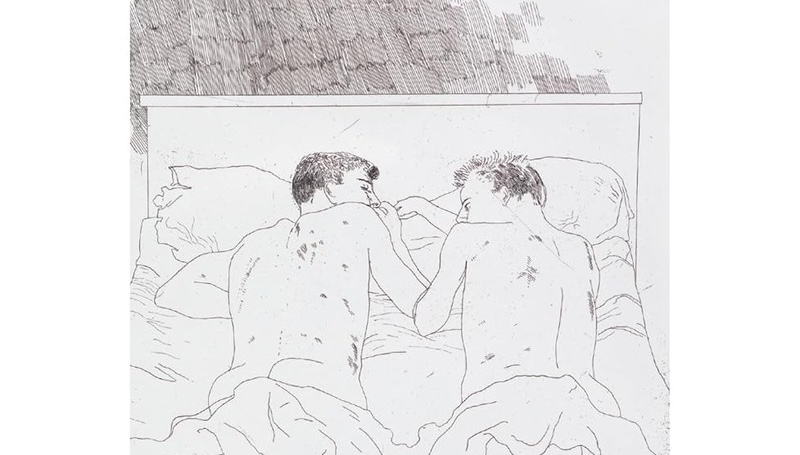
In August 1991, in a review of a new anthology of sixteenth-century poetry, Thom Gunn noted two poems by Sir Thomas Wyatt. These were poems that dealt directly with the execution of friends and associates of Wyatt’s, including Anne Boleyn. To call the poems poignant would be to undervalue their direct power.
The fourth stanza of the shorter one reads: The bell tower showed me such sight That in my head sticks day and night. There did I learn out of a grate For all favour, glory, or might That yet circa Regna tonat. (The Latin refrain means: [Jove] thunders round a throne.) “We may assume that the sight was of Ann’s beheading,” Gunn wrote. The second poem, he continued, also “mourns the death of the five with whom the Queen was supposed to have committed adultery…The range of [Wyatt’s] feeling is considerable, for he thinks as he grieves…And he distinguishes between them [the dead men], telling the reader how each meant something different to him; but in these lines he weeps for all: And thus, farewell, each one in hearty wise.
The axe is home, your heads be in the street. The trickling tears doth fall so from mine eyes, I scarce may write, my paper is so wet.” Gunn wrote of these four lines: “The axe’s work is over and their heads are on display, but the phrases employed are so mildly, almost comfortably familiar that they increase the horror of the line, of which the implication might be that executions have become by now an everyday and homely routine. The understated force is such that it spills over into a kind of authentification of the next two lines, making us read as simple truth an imagery that might otherwise have seemed commonplace in its overstatement.” These poems deal with ideas of strength and weakness; they dramatize the body itself, as though it were a country in revolt that was once a place of ease or even ecstasy.
The close attention Gunn paid to these two elegies for Wyatt’s friends does not mean that Gunn was actually influenced by these poems when he wrote his own elegies for his own dead friends in the volume The Man with Night Sweats, published in 1992. Rather, we see here and in other essays how alert Gunn was to the style and syntax of English poems of lament, the strategies of control and containment as much as the scrupulous enactment in the diction itself and in the prosody of wavering levels of dark and complex feeling. Gunn analyzed the inherited poetic tradition of lament.
Of Ben Jonson’s “To Heaven” and “On My First Sonne,” for example, he wrote: “The emotions in these two poems are difficult, scrupulously created, and qualified: he cannot live with despair more than any man, but he also cannot pretend that willed equanimity is simple or constant.” Of W. Yeats’s “In Memory of Major Robert Gregory,” Gunn wrote of “the care and the cunning of the style” and noted, “its very finish, serving to place all impulsive decisions many drafts anterior to the version we read.” In the first stanza of Gunn’s title poem, “The Man with Night Sweats,” it is as though there is a struggle going on between Latin and Anglo-Saxon as there is between health and illness. I wake up cold, I who Prospered through dreams of heat Wake to their residue, Sweat, and a clinging sheet.
Of the twenty words in these four lines, seventeen have only one syllable; only two—”prospered” and “residue”—derive from the Latin. The tone is direct, precise; the “clinging sheet” is not a metaphor or a figure of speech, it is emphatically an actual sheet that is literally damp with sweat. But this single-sentence statement is not simple or casual.
Extract — continue reading at the source.