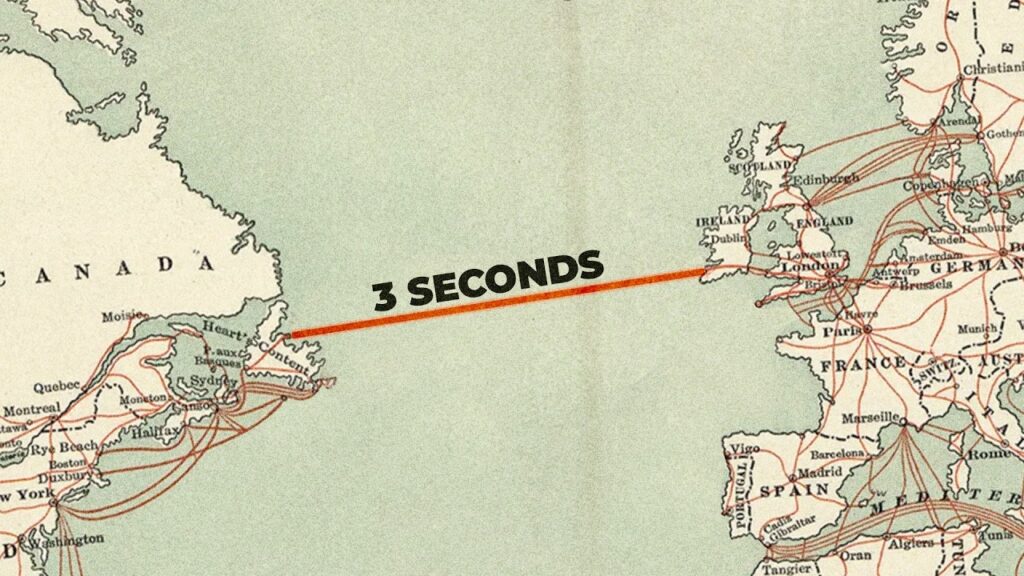
The word wireless is going the way of computerized and portable, and for much the same reasons. We no longer regard wireless devices that require no physical connections to anything else as marvels, but as something close to necessities. But our age, with its increasingly common assumptions that information just travels through the air, owes its existence to wires — and, in a historical sense, to one set of wires in particular, whose story is told in the Primal Space video above.
Woven into a mighty 2,000-mile-long cable, it was laid across the Atlantic Ocean 168 years ago, enabling the first direct communication link between North America and Europe. Not that intercontinental video sharing was just around the corner. No, the height of communication technology at the time was the telegraph: the Victorian Internet, if you like, to borrow the title of the book by Economist editor Tom Standage that inspired the video.
As a technology, telegraphy itself is quite a bit older than the aforementioned transatlantic cable. One possible starting point is 1746, when scientist Jean-Antoine Nollet managed to send a jolt of static electricity all the way down a line of 200 monks. Another is 1792, when inventor Claude Chappe’s system of semaphoric towers was first implemented.
Though described as a telegraph, it used no electricity: if a human operator up in one of the towers spotted a change in the signal of the previous one, he’d rearrange his own semaphores to match it, and so on down the line. In 1800, Alessandro Volta’s chemical battery helped make the electric telegraph viable, but nobody was sure how best to transmit intelligible messages in the form of electrical pulses. Nobody was sure, that is, until the eighteen-thirties, when a painter named Samuel Morse came up with the dot-and-dash code that now bears his name, as well as the devices used to encode and decode communications made with it.
At the same time, English inventors William Cooke and Charles Wheatstone had come up with their own telegraph system that didn’t require a codebook, though its five wires made it more expensive and technologically complex. Within a few years, the U.S. and the U.K. had independently built thousands of miles of telegraph lines, making the next step of linking them together obvious, if easier said than done. Though the cable laid in 1858 failed within months, its basic concept has proven unusually robust.
Without the roughly 600 undersea cables through which global internet traffic now flows, after all, you wouldn’t be reading this post — to say nothing of watching the video. Discover the Mundaneum, an Early 20th-Century “Internet” That Put the World’s Knowledge on Millions of Index Cards What the Entire Internet Looked Like in 1973: An Old Map Gets Found in a Pile of Research Papers A Fascinating 3D Animation Shows the Depths of the Ocean Mark Twain Predicts the Internet in 1898: Read His Sci-Fi Crime Story, “From The ‘London Times’ in 1904” Based in Seoul, Colin Marshall writes and broadcasts on cities, language, and culture. He’s the author of the newsletter Books on Cities as well as the books 한국 요약 금지 (No Summarizing Korea) and Korean Newtro.
Extract — continue reading at the source.