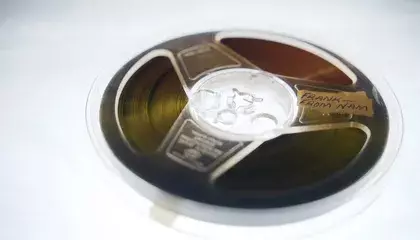
During World War II, American soldiers stationed abroad could step into a portable isolation booth and record a brief message to a loved one. Once the machine had created a 78-rpm record, the soldier could slip it into an envelope for the folks back home. By the Vietnam era, some soldiers were using higher-fidelity reel-to-reel tape recorders to create audio letters—poignant, often funny, sometimes remarkably intimate.
Private First Class Frank A. Kowalczyk, a 21-year-old United States Army soldier from the South Side of Chicago serving at Long Binh Post near Saigon, was eager to give it a try. After purchasing a recording machine from another soldier, he recorded a tape to send to his mother back home.
During the 43-minute runtime of the tape (his mother would record her own message on the other side and mail it back to him), Kowalczyk relays the realities—and, in many cases, banalities—of war while making touching inquiries about friends and family back in Calumet City, Illinois. The format also encouraged a different kind of communication from letters: In an almost stream-of-consciousness monologue, Kowalczyk wonders if his father is back to working 12-hour shifts and how his siblings are doing in school and elsewhere (“Billy still the big Casanova, or has Paulie taken over his place now?”). He asks about his income tax statements and engages in neighborhood gossip, saying he hopes Carol down the block didn’t marry George.
Manda Kowalczyk, Frank’s daughter and an accessions officer at the Smithsonian’s National Postal Museum in Washington, D.C., says that her father “was the oldest in the family and was always kind of the keeper of his siblings.” She recalls: “Hearing my dad asking about my aunts and uncles ... seemed very much like my dad.” At times, the grave circumstances of the war interrupted Kowalczyk’s thoughts. He mentions a soldier from his company who bled out in a bunker because nobody came to rescue him. The tape also indicates that he chafed when working in the sprawling Long Binh Post facility, the command and logistics hub where superior officers kept enlisted men busy tending to their work and living spaces and “asking you silly questions.” “I’m going to keep asking to go back out there,” he says.
They treat you like a man out there, not like they do over here.” Did you know? How many letters went back and forth during the Vietnam War? Cu Chi was also sending out around 1,000 pounds of mail daily to the Air Mail Terminal at Tan Son Nhut for shipment home.
At one point, the buzz and wash of a passing helicopter interjects. This is happening in Vietnam.” “That’s a moment that you can’t get in a written letter,” says Lynn Heidelbaugh, a curator at the National Postal Museum who acquired the tape from the family in 2011 while researching “Mail Call,” now a permanent exhibition. Like many soldiers of the era, her father didn’t talk much about his experiences in the war, and the audio recording he made half a world away remained stashed in a basement until she mentioned the exhibition.
Extract — continue reading at the source.