African savanna elephants are considered ecosystem engineers. For up to roughly 70 years, each massive animal rips through trees and brush, digs wells in the ground and spreads seeds in its poop. But even after their lives have ended, the hulking pachyderms continue making contributions to the environment, according to a study published October 12 in the journal Proceedings of the National Academy of Sciences.
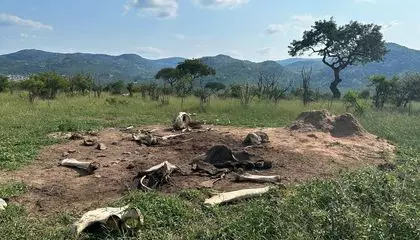
Scientists found a surprising chronology of events—involving microbes, plants and animals—near elephant remains that persists for at least eight years. The work highlights a relatively new line of research into how mega-carcasses affect the land. That curiosity turned into a larger effort to investigate soil chemistry, microbiology, biodiversity and herbivores feeding near 40 elephant carcasses in the park between 2023 and 2025.
The animals had died between eight days and almost eight years before sample collection. Analyses revealed that initially, the large animal’s body kills off all biomass directly beneath it. Scavengers also swoop in to feast on the carcass, clearing the surrounding area.
The remains leak nutrients into the ground, drastically boosting their levels. The sheer amount is toxic and stops their growth. On the other hand, microbial activity in the soil increases, though only in a small number of species.
Once the nutrient concentrations eventually go down, plants behave similarly to the microbes, with just some fast-growing species taking over the hyperlocal environment for at least around eight years. These greens are particularly nutritious and attract grazing animals, which keep coming back to the site and fertilizing the land with their poop. Savanna elephants are larger and have outward-curving tusks, while forest elephants are darker and have straighter, downward-pointing tusks.
The phenomenon somewhat resembles what happens when a whale dies. Its body sinks to the bottom of the ocean—a process called whale fall—and can fuel a jump in biodiversity and activity from all the organisms it attracts. It provides a plethora of nutrients in the deep ocean, where they’re scarce.
Extract — continue reading at the source.