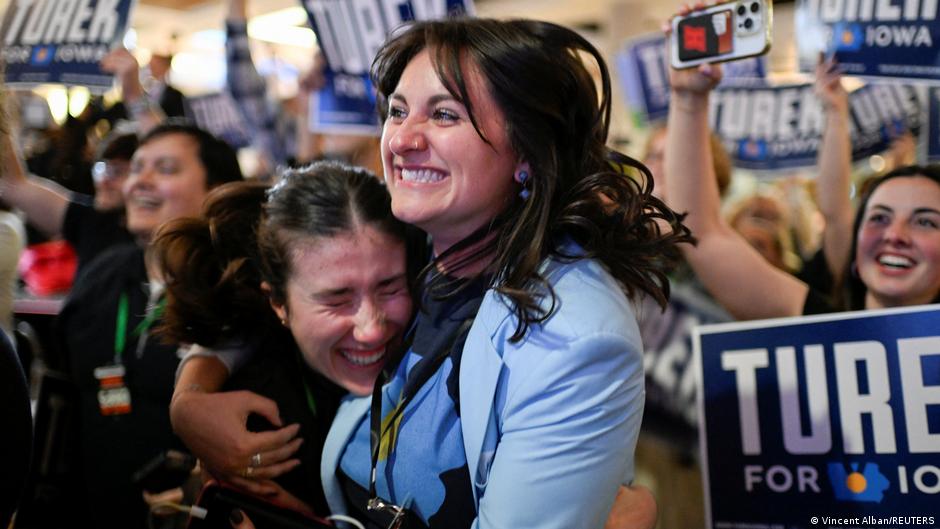
Some are even calling it a "blue tsunami." The Democrats scored a decisive victory in the midterm elections on November 3, wresting the majority from President Donald Trump's Republicans in both the US House of Representatives and the Senate. They also won gubernatorial elections in former Republican strongholds such as Texas. Pictures from Tuesday evening show Democrat politicians and supporters across the country celebrating, hugging, even weeping with joy.
However, as the White House reminded Americans in a post on X the day after the elections: "Trump is still your president." Trump has the power to veto any proposed legislation Congress puts before him, and his veto can only be overruled by a two-thirds majority. Also, in the past he has, on occasion, simply ignored the Congress's decision. Patrick Malone, professor at the public administration and policy department at American University in Washington DC, told DW that a presidential veto is not necessarily the end of the matter — even though the Democrats don't have a two-thirds majority in either Congressional chamber.
"There are Republicans, especially on the House side, who are not going to want to tie themselves that closely to Trump anymore," says Malone. "The Republicans that survived had a very strong message sent to them. It would be illogical and foolish for them to point to a neighboring district [that turned blue] and say, 'Well, that can't happen here.'" For that reason, Malone predicts that Republicans and Democrats may come together to overrule a Trump veto.
"It could happen very easily." A question at the front of many people's minds is: Might the Democrats make another attempt at impeachment? One possible basis for this would be that Trump started the war with Iran without congressional approval. The US Constitution says only Congress has the power to declare war.
But as commander-in-chief, the president also has a degree of military authority. How far this extends without Congressional approval is legally disputed. From January 2027, Democrats will have the simple majority required to bring charges against him in the House of Representatives.
They will not, however, be able to muster the two-thirds majority in the Senate that would be needed for a conviction and Trump's removal from office. Some Democrats say it is nonetheless imperative that the impeachment process be initiated, as a way of keeping the president in check. "If we make Donald Trump the center of our focus, we will lose this moment in history," the Democratic senator Cory Booker said.
Extract — continue reading at the source.