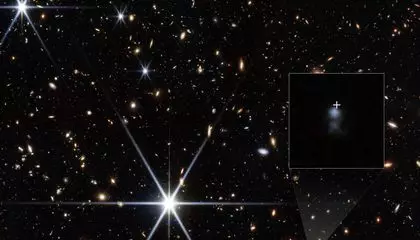
About ten billion years ago, in a faraway galaxy, some astronomical object released a brief but extremely powerful burst of energy into the universe. Now, scientists have detected that flash and figured out where it came from. The findings, published in the journal Science on October 8, mark the oldest fast radio burst (FRB) ever detected.
The mysterious flash was produced during the early universe, so it can help scientists better understand the ancient cosmos. A dense cloud of gas and dust collapsed and formed a swirling disk of material. It continued pulling in more space stuff until immense pressure in the core birthed the sun.
FRBs are short but powerful flashes of radio waves. The first one was discovered in 2007, and thousands of them have been detected ever since. However, scientists still aren’t sure what produces the outbursts.
One possibility is that they originate from the merging of two neutron stars, extremely dense remnants of dead giant stars. Another hypothesis is that they’re emitted by magnetars, rare types of young neutron stars with powerful magnetic fields. Researchers previously showed that at least one FRB probably came from a magnetar, but that doesn’t mean all of them are made by these strange stellar leftovers.
Detecting and measuring FRBs, as well as the galaxies they came from, can help solve this puzzle, says study co-author Themiya Nanayakkara, an astrophysicist at the University of Sydney, to Scientific American’s Adam Kovac. The MeerKAT radio telescope array in South Africa detected the newly described flash of radio waves, dubbed FRB 20240304B, in March 2024. The different frequencies of energy within the burst—like the rainbow produced when white light passes through a prism—arrived at different times, suggesting that the FRB traveled through a lot of plasma in outer space before reaching Earth. (The greater the dispersion of frequencies, the longer the distance traveled.) Then, the researchers used NASA’s James Webb Space Telescope (JWST) to pinpoint the FRB’s origins.
Analyses revealed that it came from a primitive galaxy that formed roughly three billion years after the Big Bang, which happened 13.8 billion years ago. It also had a low amount of metal. That’s consistent with the idea that FRBs originate from magnetars, Nanayakkara and Caleb write for the Conversation, hinting that FRB 20240304B came from one.
Extract — continue reading at the source.