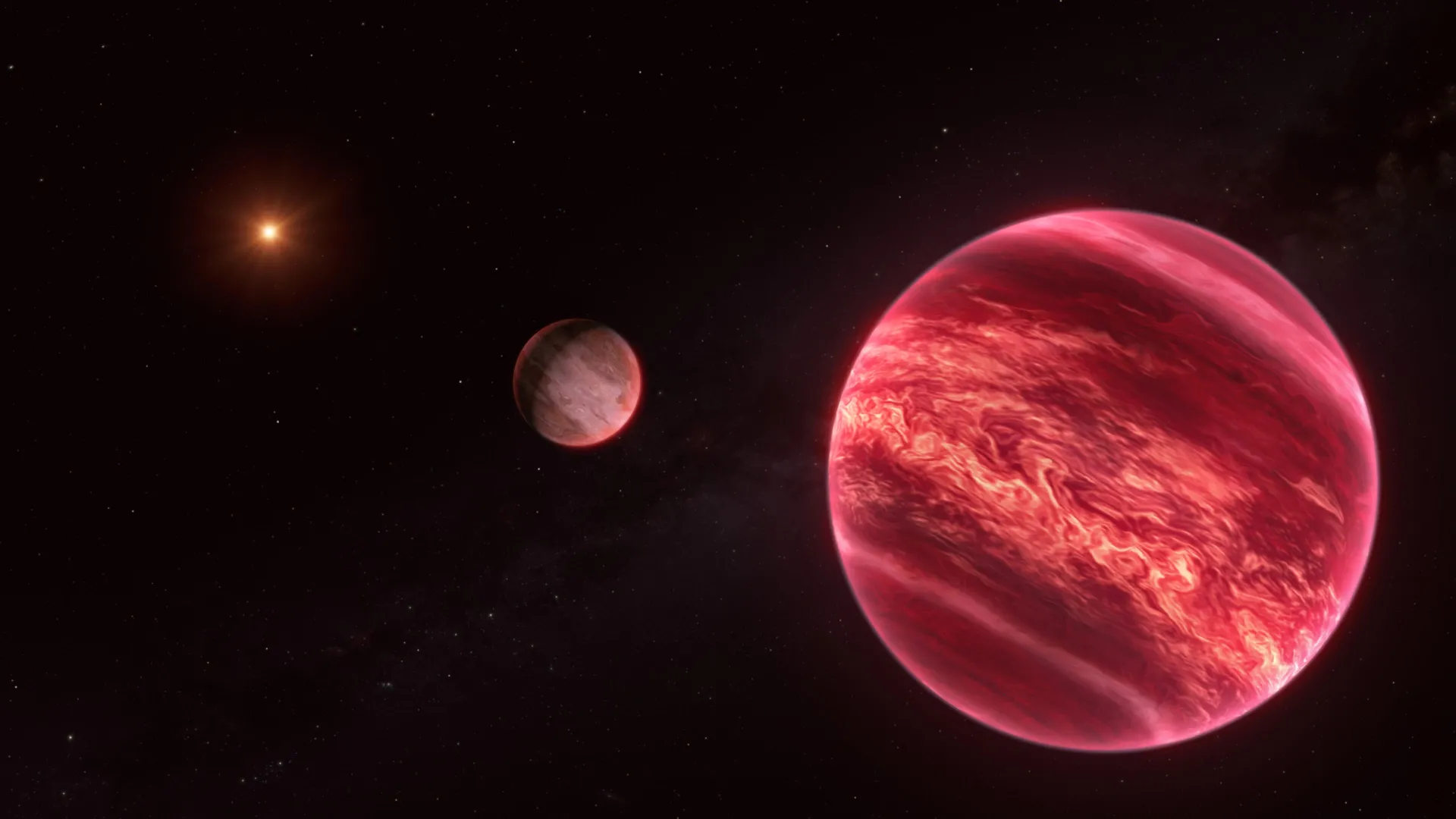
Astronomers may have found the first moon beyond our Solar System, but the mysterious object is unlike any moon we know. Observations from the European Southern Observatory's Very Large Telescope (ESO's VLT) have uncovered evidence of an enormous moon-like body in the CD-35 2722 star system. Rather than orbiting a planet, this unusual object circles a brown dwarf, a celestial body more massive than a planet but not massive enough to become a star.
If confirmed, the discovery could mark the first detection of a natural satellite outside our Solar System, potentially changing how astronomers define moons and planets. Kevin Hoy, an ESO student based in Chile and lead author of the study published in Nature, spent months examining the CD-35 2722 system. He describes its unusual arrangement as "super weird" compared with our own Solar System.
At the center of this relatively young system is CD-35 2722, a star with approximately half the Sun's mass. Orbiting the star is a brown dwarf, an object that occupies the murky boundary between planets and stars. Brown dwarfs are generally too small to sustain the hydrogen fusion that powers ordinary stars, yet they are more massive than planets.
The newly identified object orbits this brown dwarf, creating a remarkable arrangement in which a massive satellite circles an object that itself revolves around a star. "This system is somewhat hard to define using Solar-System-based words like 'planet' and 'moon'," states Hoy, who is also affiliated with the Universidad Diego Portales and the Millennium Nucleus of Young Exoplanets and their Moons (YEMS) in Chile. The researchers refer to the newly detected object as an exosatellite.
It has at least as much mass as Jupiter, while the brown dwarf it orbits is more than 30 times as massive as Jupiter. This makes the possible moon far more massive than any natural satellite in our Solar System. "The exosatellite is clearly massive enough to be a planet, but it does not orbit a star, though it orbits an object that orbits a star," says Hoy.
"Being the third wheel in this system makes us want to call it a moon, even if it is nothing like the small, rocky moons we have in our system." A Giant Exomoon That Challenges Cosmic Definitions The unusual discovery highlights a fundamental problem with applying familiar astronomical labels to objects found in distant star systems. An exosatellite is a natural satellite located beyond our Solar System, while the term exomoon generally refers to a natural satellite orbiting a planet or another celestial body outside our Solar System. However, astronomers have not established a universally accepted definition of an exomoon.
Extract — continue reading at the source.


