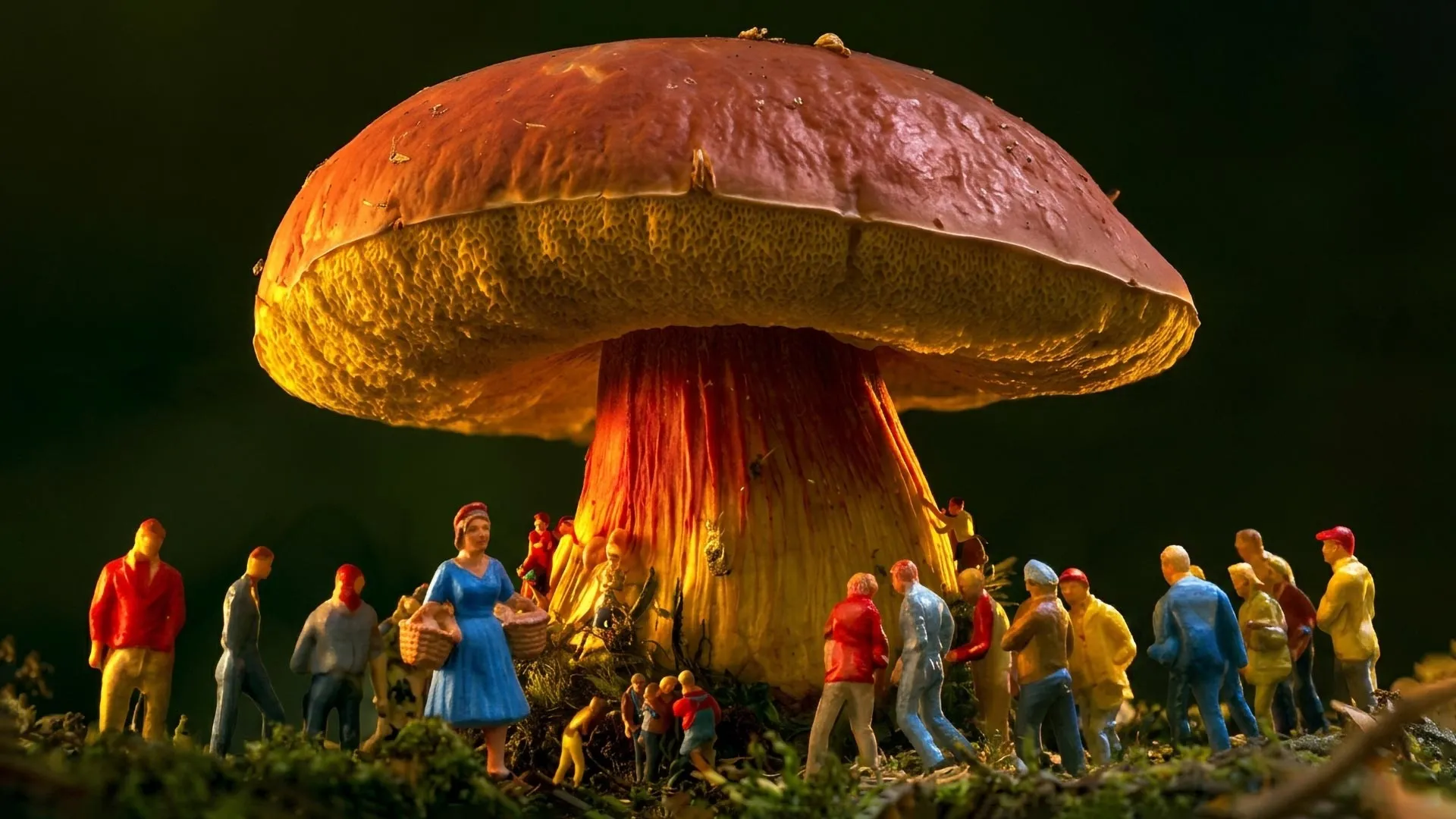
People living thousands of miles apart have reported an extraordinarily strange experience after eating certain wild mushrooms. They begin seeing tiny human figures that appear to move through the real world, walking around objects, climbing over surfaces, and interacting with their surroundings. These visions are known as Lilliputian hallucinations, named after the miniature inhabitants of "Gulliver's Travels," who stand just 6 inches tall.
For decades, researchers suspected that cultural beliefs and folklore might explain why people in different regions described such similar experiences. Now, a new study provides evidence that the phenomenon has a biological explanation. Researchers at the University of Utah (U) used DNA sequencing to identify Lanmaoa asiatica as the mushroom responsible for these unusual hallucinations in Southwest China and the northern Philippines.
Surprisingly, their investigation found no evidence of any known psychoactive mushroom compounds, including psilocybin. The findings suggest that the mushroom may produce an entirely unfamiliar hallucinogenic substance. Identifying that chemical could help scientists better understand neurological disorders, unusual visual experiences, and the processes through which the brain creates our perception of reality.
The research was conducted by Colin Domnauer, a doctoral student at the U, and Bryn Dentinger, a mycologist affiliated with the university and the Natural History Museum of Utah. Their findings were published in the journal Mycologia. In an interview with @theU, Domnauer explained how researchers traced the mushroom's identity, what makes its effects so unusual, and why the discovery could have implications far beyond the study of fungi.
A Century-Old Mystery of Tiny Human Hallucinations The scientific mystery dates back to 1934, when Western researchers learned that people in Papua New Guinea sometimes experienced vivid visions of miniature humans after eating wild mushrooms. The bizarre effect became known as "mushroom madness." During the 1950s and 1960s, anthropologists and mushroom specialists traveled to Papua New Guinea to investigate. Their work pointed toward several possible species belonging to the Boletaceae (bolete) family.
However, chemical testing failed to reveal any substances that could explain the hallucinations. Samples were even examined by Albert Hofmann, the scientist who first isolated psilocybin and discovered LSD. He, too, was unable to identify an active ingredient.
Extract — continue reading at the source.


