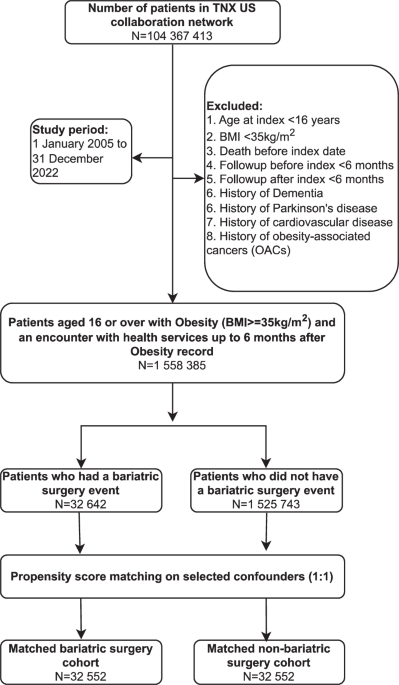
We aimed to evaluate the association between bariatric surgery (BS) and the incidence of dementia and Parkinson’s disease. To assess consistency with established benefits of BS, we examined its association with cardiovascular disease, obesity-associated cancers, and all-cause mortality. We conducted a longitudinal cohort study using electronic health records from TriNetX network.
Patients aged ≥16 years with at least one BMI record of ≥35 kg/m2 between 1st Jan 2005 and 31st Dec 2022 were included. The exposed cohort included those who underwent a BS; the unexposed cohort included everyone without BS. The index date was the earliest date for BS up to 6 months after a BMI of ≥35 kg/m2 for the exposed, and the earliest encounter code up to 6 months after a BMI of ≥35 kg/m2 for the unexposed.
Individuals were 1:1 matched using propensity score matching on covariates age at index date, gender, ethnicity, race, BMI, hypertension, type 2 diabetes (T2D), socioeconomic status, smoking, alcohol, and history of neurological diseases. Cox proportional hazards regressions were performed for each outcome. After matching, there were 32,552 individuals each in the BS and non-BS group.
The median follow-up was 4.7 years in individuals with BS and 5.9 years in those without. Compared to the non-BS group, individuals who underwent BS had significantly reduced incidence rates of dementia (hazard ratio 0.48, 95% CI: 0.39–0.58) and Parkinson’s disease (0.70; 0.51–0.96). Similar associations were observed for CVD (0.53; 0.51–0.56); obesity-associated cancers (0.66; 0.60–0.72) and all-cause death (0.46; 0.41–0.51).
Survival probability at 20-years was 84.7% (95% CI: 71.1–92.3%) in the BS group vs 81.8% (77.5–85.4%) in those without. BS was associated with a lower incidence of dementia and Parkinson’s disease in individuals with BMI ≥ 35 kg/m2, in addition to reducing CVD, obesity-associated cancers, and mortality, suggesting potential neuroprotective and systemic health benefits. Obesity is a major global health challenge and a leading cause of morbidity and premature mortality.
It is strongly associated with a range of diseases including cardiovascular disease, type 2 diabetes (T2D), and several obesity-associated cancers [1, 2]. In addition to these well-established associations, there is growing recognition of obesity as a potential risk factor for neurodegenerative conditions such as dementia and Parkinson’s disease [3,4,5]. This link may be mediated through obesity-related metabolic dysfunction, including insulin resistance, T2D and hypertension, as well as through biological mechanisms such as chronic systemic inflammation, oxidative stress, vascular dysfunction and altered lipid metabolism, all of which can lead to neuronal damage and cognitive decline [6, 7].
Extract — continue reading at the source.


