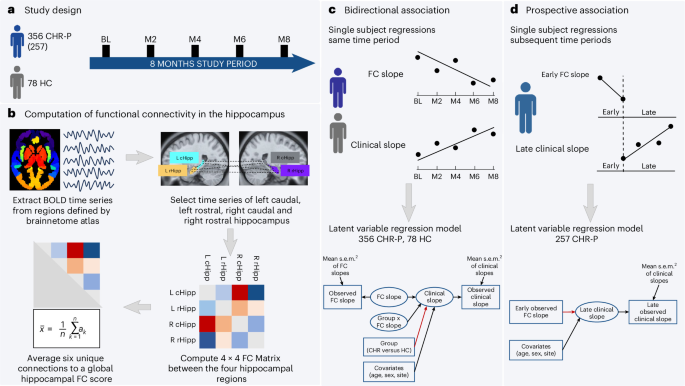
Psychotic disorders lack treatment-informative biomarkers, especially during the earliest illness stages when interventions are most effective. Here, integrating etiological theories on hippocampal pathology and whole-brain dysconnectivity, we studied connectivity changes within the hippocampus as a neuroimaging marker of emerging symptomatic and functional trajectories in the psychosis risk state and explored effects on conversion to psychosis. We used observational cohort data from the multicenter North American Prodrome Longitudinal Study (NAPLS-3).
Longitudinal clinical and functional neuroimaging data from 434 participants (356 individuals at clinical high risk for psychosis and 78 healthy controls) collected across an 8-month period were analyzed using latent variable regression models. Decreases of intrahippocampal connectivity over time tracked worsening negative symptoms, depressive symptoms and psychosocial functioning in at-risk individuals. This finding was not observed for attenuated positive symptoms and cognition, was specific to high-risk individuals relative to healthy controls and was not obtained for connectivity within other brain areas.
Unveiling the temporal sequence of these associations, we found that an early decrease in connectivity within the hippocampus preceded a subsequent worsening of negative symptoms, but not vice versa. At the same time, intrahippocampal connectivity decline did not predict transition to psychosis. These findings position intrahippocampal connectivity changes as a potentially transdiagnostic neuroimaging marker of early affective–motivational and functional trajectories in at-risk individuals.
Early reductions in intrahippocampal connectivity may aid in stratifying at-risk individuals according to their expected affective and functional outcomes and may represent a novel neurostimulation target to prevent unfavorable clinical trajectories. This is a preview of subscription content, access via your institution Receive 12 digital issues and online access to articles Prices may be subject to local taxes which are calculated during checkout The data supporting the findings of this study cannot be made publicly available as they require data access permission provided by the NIMH Data Archive (NDA, https://nda.nih.gov). Code is publicly available via GitHub at github.com/LuRoe7/HippoConCHR/tree/main.
Jauhar, S., Johnstone, M. & McKenna, P. Lancet 399, 473–486 (2022). On the proportion of patients who experience a prodrome prior to psychosis onset: a systematic review and meta-analysis.
Psychiatry 29, 1361–1381 (2024). Poletti, M., Pelizza, L., Preti, A. & Raballo, A. Clinical high-risk for psychosis (CHR-P) circa 2024: synoptic analysis and synthesis of contemporary treatment guidelines.
Extract — continue reading at the source.


