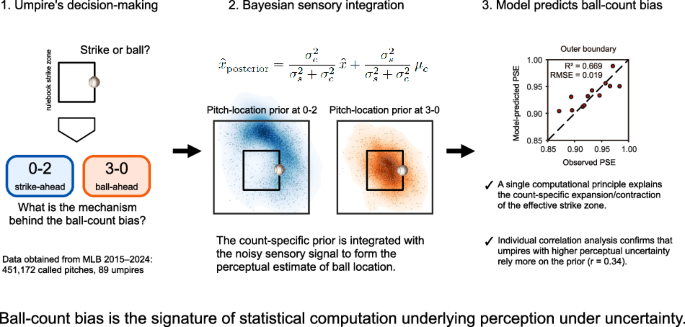
Bayesian sensory integration, the brain’s strategy of combining noisy sensory evidence with prior expectations in proportion to their relative reliability, is one of the most influential frameworks in cognitive neuroscience, yet its validity has been primarily demonstrated in controlled experimental settings. Whether it also governs real-world expert decision-making remains largely untested. Here, we leveraged 451,172 called pitches from ten seasons of Major League Baseball (2015–2024) to ask whether the count-dependent bias in umpire strike–ball judgements, a systematic expansion and contraction of the effective strike zone depending on the ball count, is a signature of Bayesian sensory integration.
We confirmed the count bias by fitting psychometric functions that quantified the umpire’s effective strike-zone boundary, the Point of Subjective Equality (PSE), at four boundaries across all 12 ball-count combinations. Fitted directly to individual binary calls, a Bayesian model that treats count-specific pitch location distributions as prior knowledge reproduced the observed PSE shifts, and outperformed a baseline model without count information at three of four boundaries, with the highest accuracy at the high and outer boundaries. Individual analyses of 89 umpires further confirmed a core prediction: umpires with higher perceptual uncertainty relied more strongly on count-specific priors, both at neutral counts and in the magnitude of their count-dependent bias.
These findings demonstrate that a fundamental principle of neural computation governs expert decision-making in the most ecologically demanding of real-world contexts, reframing count-dependent bias not as umpire error but as a phenomenon consistent with the rational use of prior information under perceptual uncertainty. This work was supported by the Japan Society for the Promotion of Science (JSPS) KAKENHI Grant Number 24K02840 (Grant-in-Aid for Scientific Research (B); Principal Investigator: Ken Takiyama) and JSPS KAKENHI Grant Number 24K14530 (Grant-in-Aid for Scientific Research (C); Principal Investigator: Masahiro Shinya). Graduate School of Humanities and Social Sciences, Hiroshima University, Higashi-Hiroshima, Japan The authors declare no competing interests.
Publisher’s note Springer Nature remains neutral with regard to jurisdictional claims in published maps and institutional affiliations. Open Access This article is licensed under a Creative Commons Attribution 4.0 International License, which permits use, sharing, adaptation, distribution and reproduction in any medium or format, as long as you give appropriate credit to the original author(s) and the source, provide a link to the Creative Commons licence, and indicate if changes were made. The images or other third party material in this article are included in the article’s Creative Commons licence, unless indicated otherwise in a credit line to the material.
If material is not included in the article’s Creative Commons licence and your intended use is not permitted by statutory regulation or exceeds the permitted use, you will need to obtain permission directly from the copyright holder. To view a copy of this licence, visit http://creativecommons.org/licenses/by/4.0/. Bayesian sensory integration explains ball-count bias in Major League Baseball umpires.
Commun Psychol (2026). https://doi.org/10.1038/s44271-026-00534-4 DOI: https://doi.org/10.1038/s44271-026-00534-4
Extract — continue reading at the source.


