Most galaxies are thought to harbor a supermassive black hole at their center. These enormous objects can weigh millions or even billions of times more than the sun, creating some of the strongest gravitational environments known in the universe. When a star passes dangerously close to one of these black holes, destruction is not always immediate.
Some stars survive the encounter and return for additional close passes, generating a fresh burst of light each time. These events, known as repeating partial tidal disruption events (rpTDEs), allow astronomers to observe the same star interacting with the same black hole multiple times. Wide-field time-domain surveys make this possible by repeatedly scanning large regions of the sky and tracking objects whose brightness changes.
Yet some of these systems have presented astronomers with a mystery. Instead of producing similar flares on each return, they become steadily fainter. For years, theoretical models struggled to reproduce that behavior.
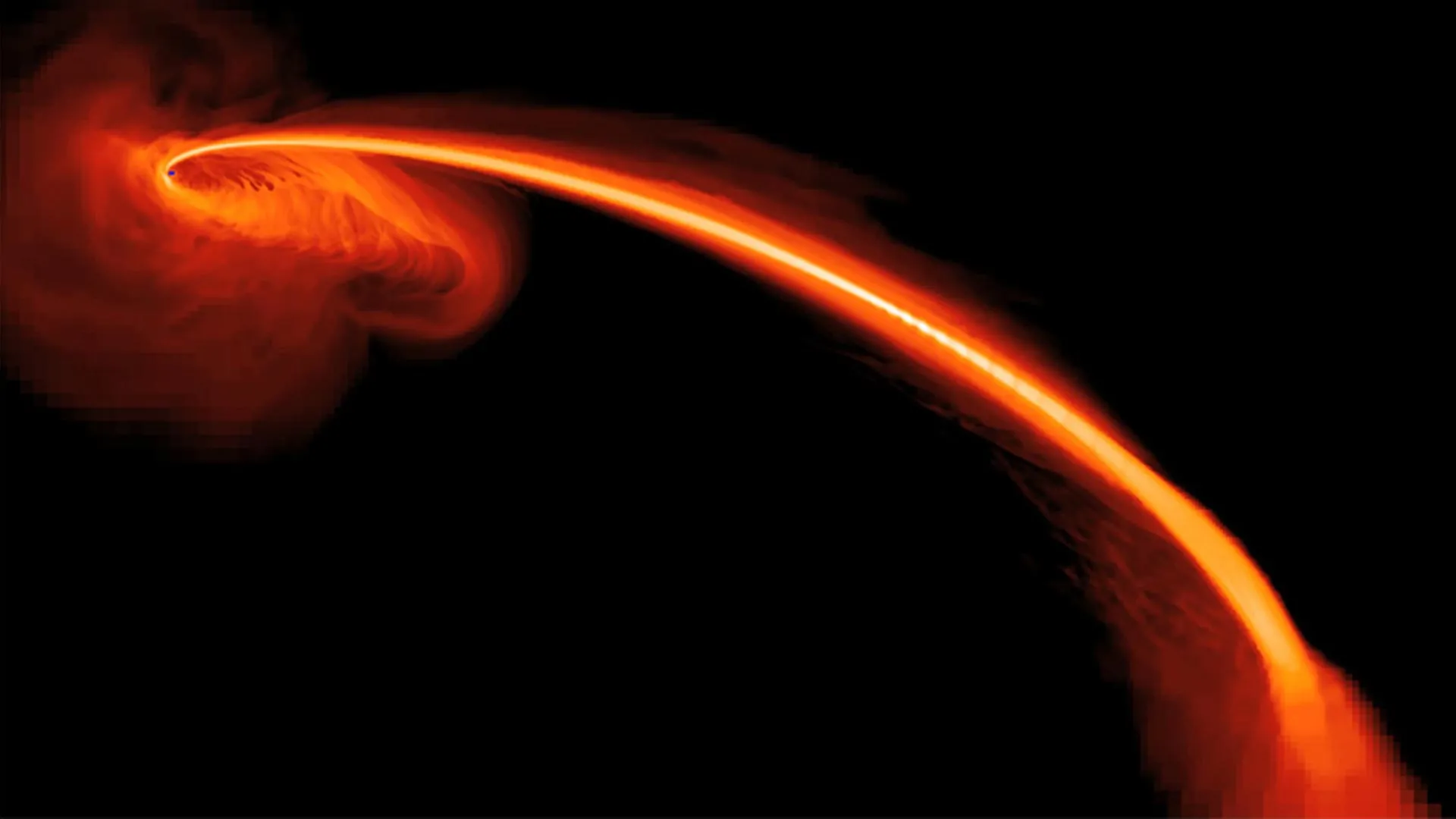
New research from astrophysicists at Syracuse University suggests that a previously underappreciated property of the star could provide the answer: how rapidly it was spinning before its first close encounter with the black hole. The study, published in The Astrophysical Journal, was led by doctoral student Ananya Bandopadhyay, working with postdoctoral researcher Benjamin Amend and associate professor Eric Coughlin, all in the Department of Physics, along with collaborators at other institutions. In a standard tidal disruption event (TDE), the gravitational pull from a black hole varies so strongly from one side of a nearby star to the other that the star is completely torn apart.
The resulting stellar debris begins falling toward, or "accretes" onto, the black hole. As that material loses energy, it releases light over periods ranging from days to months. Black holes themselves do not emit light, but a TDE temporarily supplies material that can illuminate the region around one.
That glow gives astronomers an indirect way to investigate objects that would otherwise be invisible. Not every encounter ends with the star being completely destroyed. If a star passes close to a black hole without crossing the threshold for total disruption, it can lose only part of its mass, producing a partial TDE.
Extract — continue reading at the source.