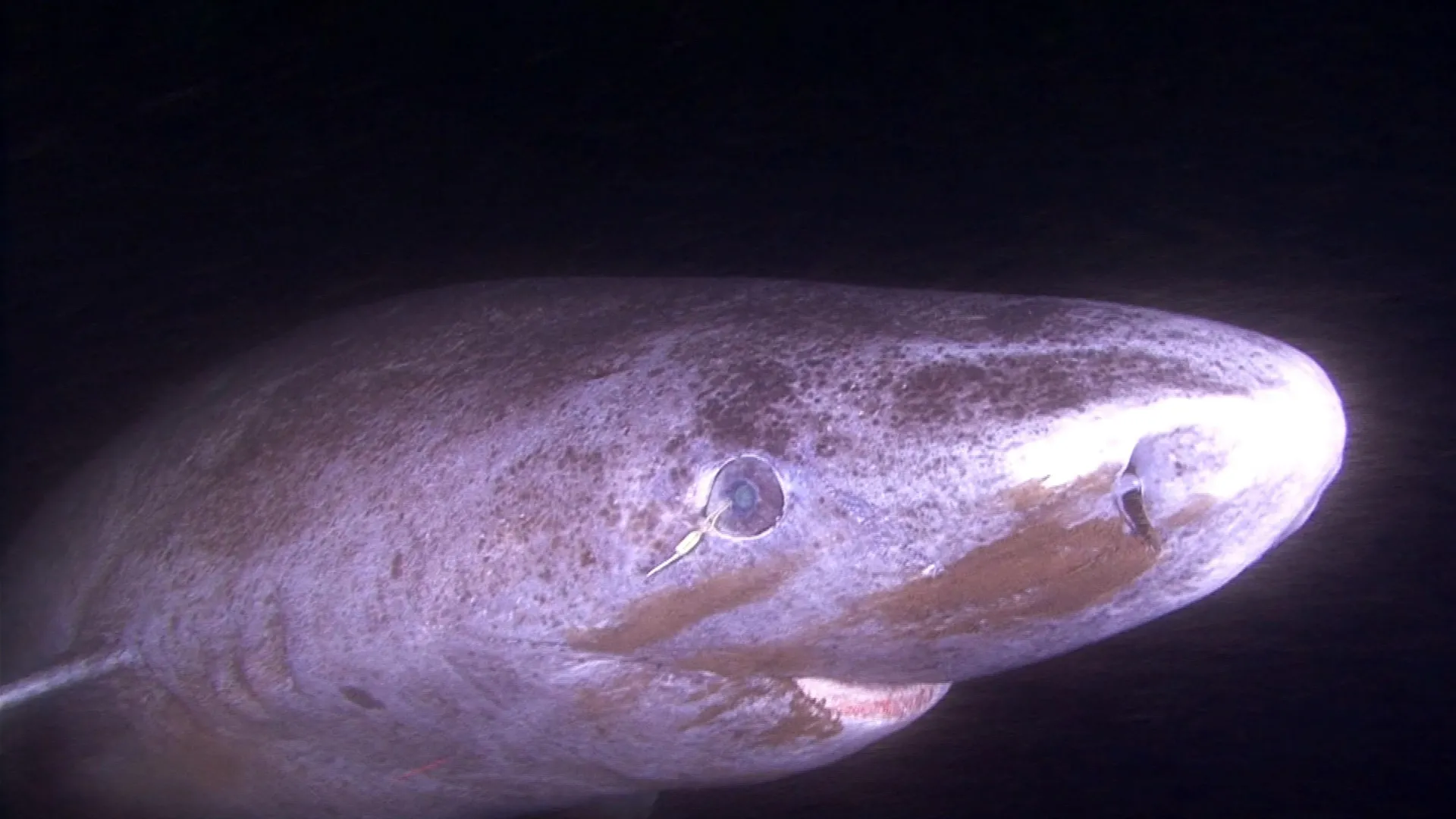
Dorota Skowronska-Krawczyk watches a Greenland shark glide slowly through the dark waters of the Arctic on her computer screen. "You see it move its eye," says the University of California, Irvine associate professor of physiology and biophysics, pointing to the footage. "The shark is tracking the light -- it's fascinating." Greenland sharks are the longest-living vertebrates known to science, with some individuals surviving for as long as 400 years.
They have thick gray bodies, small heads and short, rounded snouts. Their cloudy-looking eyes can appear almost lifeless, and parasites are often found attached directly to the eyeballs. Because of those parasites and the extremely dark, murky environment in which the sharks live, scientists have long suspected that Greenland sharks may be functionally blind.
New research led by Skowronska-Krawczyk, however, suggests a very different picture. The study, co-authored by researchers from the University of Basel, Switzerland, Walter Salzburger and Lily G. Fogg, who examined the evolutionary aspects of the work, is challenging assumptions about Greenland shark vision while offering new clues about aging and longevity.
Published in Nature Communications, the findings suggest that a DNA repair mechanism may allow Greenland sharks to preserve their eyesight for centuries without showing signs of retinal degeneration. Their visual systems also appear specially adapted to the extremely low light levels of their Arctic habitat. Skowronska-Krawczyk studies the molecular processes involved in age-related eye diseases to better understand how aging affects vision.
Her interest in Greenland sharks began after reading a 2016 research paper by John Fleng Steffensen published in the journal Science. "One of my takeaway conclusions from the Science paper was that many Greenland sharks have parasites attached to their eyes -- which could impair their vision," she says. "Evolutionarily speaking, you don't keep the organ that you don't need.
After watching many videos, I realized this animal is moving its eyeball toward the light." That observation prompted her to investigate the sharks' visual system more closely. The Greenland sharks examined in the study were caught between 2020 and 2024 with scientific long lines near the University of Copenhagen's Arctic Station on Disko Island, Greenland. Steffensen, a professor of marine biology at the University of Copenhagen, worked with Peter G.
Extract — continue reading at the source.