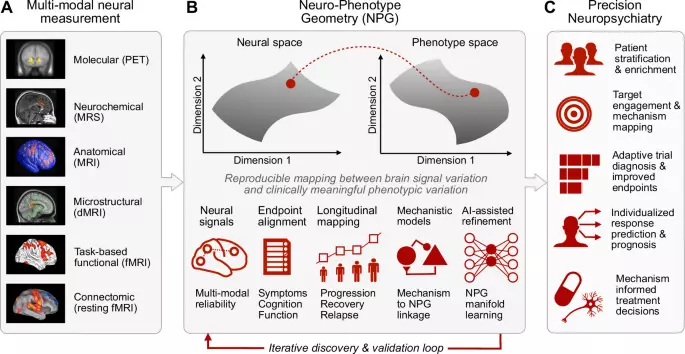
Neuroimaging has transformed the study of psychosis spectrum disorders (PSD), yielding major advances in our understanding of disease biology across molecular, circuit, and systems levels. Positron emission tomography established robust evidence for striatal dopamine dysfunction; magnetic resonance spectroscopy identified glutamatergic abnormalities, particularly early in illness; task-based functional MRI revealed impaired fronto-parietal recruitment during cognitive operations such as working memory; and resting-state fMRI uncovered widespread alterations in thalamo-cortical organization. Yet despite these achievements, the field has struggled to translate biological insight into precision therapeutics.
A central limitation is the absence of reproducible brain–behavior associations, formalized here as neuro-phenotype geometry (NPG). NPG refers to the reproducible structure of associations between inter-individual variation in neural systems and clinically meaningful variation in symptoms, cognition, function, and illness trajectory. We argue that reproducible NPG is a central statistical object for imaging-enabled therapeutic development because both patient selection and endpoint optimization depend on it.
Furthermore, translation also requires alignment with endpoints on a regulatory path, which in PSD remains narrow, centered largely on PANSS-based symptom measures and MATRICS-informed cognition. Robust NPG signatures should be linked to disease-modifying mechanisms through neurobiologically grounded computational models, situated within longitudinal designs that respect the dynamic nature of illness, and derived from multimodal datasets capable of capturing pathophysiology across scales. This agenda defines the scientific and translational priorities needed to unlock genuinely mechanism-based precision treatment in psychosis.
Psychosis spectrum disorder (PSD) is among the most debilitating neuropsychiatric syndromes, disrupting cognition, motivation, belief formation, perception, and functional life trajectories. Symptoms often begin early in life, interfering with education, vocational development, and social functioning during periods of major developmental vulnerability. However, neuropsychiatry has not delivered mechanistically grounded disease-modifying therapies for this devastating illness.
To reach that objective, the field needs a mapping between viable treatment targets, affected neural systems, and time-evolving clinical phenotypes. Human neuroimaging has generated a large body of evidence spanning structural magnetic resonance imaging (MRI), magnetic resonance spectroscopy (MRS), resting-state and task-based functional connectivity, diffusion imaging, and positron emission tomography (PET)1,2,3,4,5,6. Collectively, these modalities reveal alterations in PSD across molecular, microstructural, circuit, and systems levels3,4,7,8,9,10.
However, major knowledge gaps still limit the value of imaging for mechanistic mapping of target engagement, patient selection in clinical trials, and trial endpoint optimization. Here we present a roadmap for the next phase of PSD neuroimaging, arguing that progress requires a shift from descriptive group differences toward stable brain–behavior mappings that align with regulatory endpoints, disease-modifying models, longitudinal designs, multimodal datasets, and AI-enabled discovery. This editorial is intended as an introduction to the Nature Portfolio Special Collection in Schizophrenia titled “Neuroimaging Biomarkers in Psychotic Disorders” organized around that translational challenge (Fig. 1).
Extract — continue reading at the source.


