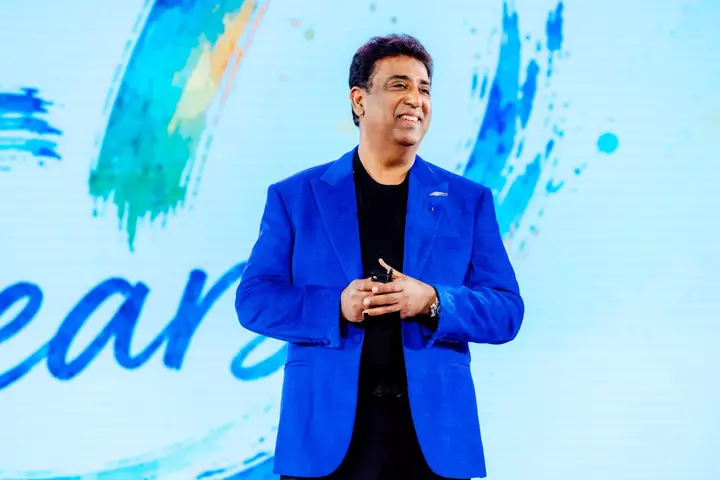
Girish Navani gets emails imploring him to sell the company and retire, "pretty much every week." They suggest that it's time for the eClinicalWorks cofounder and CEO to get on the golf course, on the water—away from the health care industry's AI arms race. The senders ask, "'Why do you keep doing this?'" Navani, 59, told customers during the keynote address at the health tech company's National Conference in Nashville last weekend. "But there is a much deeper sense of what we do and the pride we take in doing it, and the purpose with which we put ourselves to this." That purpose is closely tied to keeping advanced health care technology within reach of providers that lack the resources of major hospital systems, Navani told Newsweek during an October 23 interview.
He believes the company can afford to give away some of its newest AI capabilities at no additional cost, even as competitors race to monetize the technology. At the conference, Navani unveiled a redesigned EHR experience, a platform for building AI agents and two new business units that will take eClinicalWorks further into inpatient care and pharmacy management. The announcements came alongside a significant financial milestone: eClinicalWorks and its patient engagement subsidiary, healow, expect combined revenue to exceed $1.3 billion in 2026.
Healow alone is projected to generate $175 million. In speaking with Newsweek, Navani said the company's growth and privately held structure give it the financial flexibility to absorb costs that might otherwise be passed along to customers. "We are a private company with no shareholders, so I have two choices, I don't have three," Navani said.
"I don't have to worry about shareholders. I only have to worry about employees, and I have to worry about my customers." That philosophy is increasingly central to the company's AI strategy, which Navani calls "democratizing AI." AI adoption is advancing unevenly across health care. A 2025 American Medical Association survey found that 72 percent of employed physicians reported using AI, compared with 64 percent of physicians in private practice.
The gap is even more pronounced among hospitals. Federal data shows that 86 percent of system-affiliated hospitals used predictive AI in 2025, compared with 37 percent of independent hospitals. Another Menlo Ventures report found that 27 percent of health systems had adopted AI, compared with 18 percent of outpatient providers.
But eClinicalWorks aims to balance the scales. "We want to make AI affordable to even the solo practice," Navani said. The centerpiece of the conference announcements was version 12.04 of eClinicalWorks' EHR, which introduces a redesigned interface called "Canvas for Care," also referred to as "Smart Canvas." Rather than requiring clinicians to navigate multiple screens, menus and pop-up windows, the new interface is designed to bring patient information, AI-generated summaries, recommended actions and relevant tasks into a single workspace.
Extract — continue reading at the source.