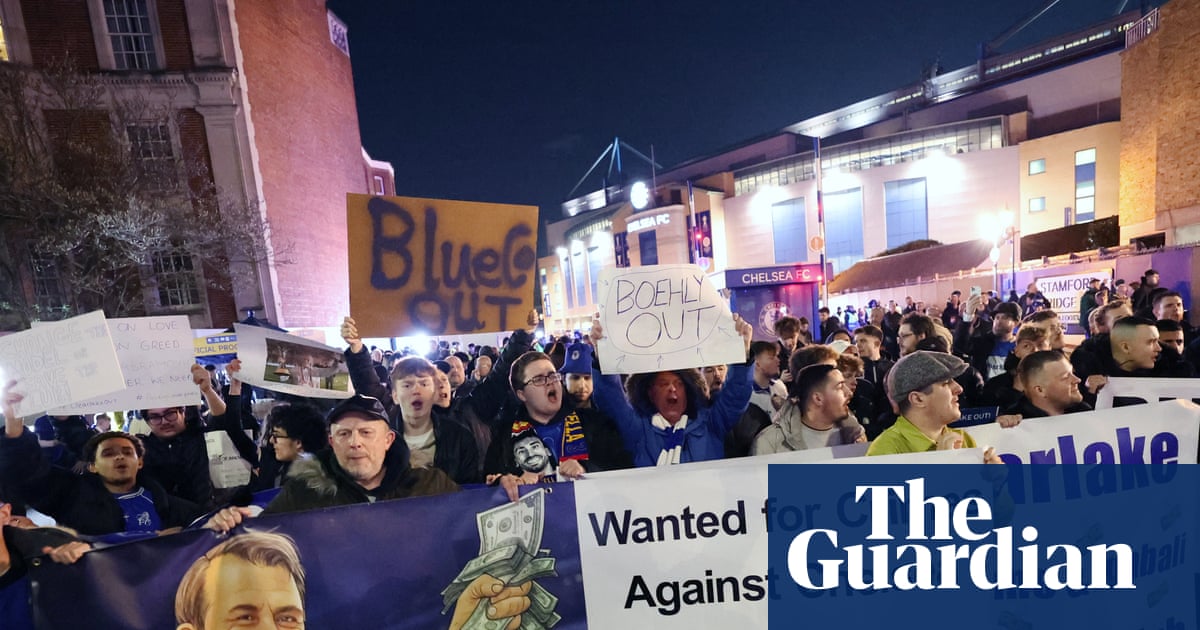
Here follows a list of the things accomplished at Chelsea Football Club during a time that historians may choose to grandly term the First Clearlake Era, or perhaps the Boehly Bungle. Since the May 2022 purchase of the club from the sanctioned Russian oligarch Roman Abramovich, when Todd Boehly took over the club’s daily operations, Chelsea – Premier League champions as recently as 2017 and 2015, and Champions League winners in 2021 – have placed 12th, sixth, fourth and 10th in the league. After the sacking of Thomas Tuchel, the incumbent upon the takeover, five permanent and four interim managers were installed.
They employ five sporting directors. About $2.37bn (£1.78bn) – with a B! – was spent on 60 new players, per Transfermarkt. The same source values Chelsea’s current first team at just $1.23bn (£920m).
And when, to put it in Professional Business Guy speak, your entire trading strategy rests on buying young players you plan to profit from later, it doesn’t seem great when you’ve spent twice as much on your portfolio of assets as it is now worth. Those signings included at least one of the Premier League’s all-time busts (Mykhailo Mudryk) and one of its worst contracts (Raheem Sterling). Chelsea set a new Premier League record for the biggest pre-tax loss.
And, infamously, the club sold its women’s team to itself as part of some accounting shenanigans to stay on the right side of financial regulations. And now let us go through the things that were not achieved: Qualifying for European competition in two of four seasons, which ought to be the rock-bottom minimum for a club of Chelsea’s means. Building a new and larger stadium, even though one was mooted.
All the same, Boehly will walk away after four years as chair of Chelsea – although his influence had recently waned – with a profit in his bank account, or wherever it is that money men of his kind stash their cash. So too will his fellow American and minority stakeholder Mark Walter, after both men sold their 12.8% shares to Clearlake Capital last week. Welcome to the final stage of the American ownership model, which has now enveloped most of the Premier League.
At this stage, members of the billionaire class just pass stakes in teams around among themselves, always for at least a bit more than they paid. They are not stewards of their clubs and don’t see themselves as such. They feel no obvious alliance or allegiance to the fans, acting only as the current holders of the paperwork that confers financial control over a valuable asset.
Extract — continue reading at the source.