Dysfunctional immune responses impair remyelination and contribute to neurodegeneration. While immune and metabolic responses to acute myelin injury are well characterized, myeloid cell adaptations to chronic myelin damage remain poorly understood. Here we performed a comparative analysis of genetic and toxic mouse models of acute and chronic demyelination, which identified a distinct microglial state associated with chronic demyelination, characterized by sustained pro-inflammatory activation, lysosomal lipid sequestration and reduced lipid droplet formation.
Transcriptomics profiling further revealed a metabolic program marked by upregulated cholesterol synthesis and diminished sterol efflux. Treatment with a desmosterol mimetic possessing 24-dehydrocholesterol reductase inhibitor activity reversed this microglial state, attenuated pro-inflammatory signaling (including C-C Motif Chemokine Ligand 4 expression), reduced myelin damage and improved motor performance in a mouse model of leukodystrophy. Our findings uncover a pro-inflammatory microglial state characterized by lysosomal dysfunction and increased myelin reactivity, highlighting a novel therapeutic target for chronic demyelinating disorders.
Demyelinating diseases are characterized by myelin damage or loss, resulting in functional decline and progressive neurodegeneration, with multiple sclerosis (MS) being the most common demyelinating disorder among young adults1,2,3. While immune-mediated attacks on myelin initiate tissue damage, the resulting injury elicits counter-regulatory responses involving the proliferation and recruitment of microglia and monocyte-derived macrophages to demyelinated lesions4,5,6,7,8. Within these lesions, myeloid cells sense and engulf damaged myelin and activate transcriptional and metabolic programs that facilitate its clearance4,8,9,10.
Following phagocytic uptake, damaged myelin is delivered to phagolysosomes, where lysosomal enzymes degrade most of its components. Cholesterol, which cannot be further degraded, is transported from endolysosomal compartments to the endoplasmic reticulum, where it is esterified and transiently stored in lipid droplets11,12,13. Subsequently, cholesterol is mobilized and exported onto extracellular lipoproteins, enabling its redistribution and potential reuse during remyelination.
Dysregulation of this program can lead to chronic, nonresolving inflammation4,14,15,16,17,18,19,20,21,22,23,24. Thus, efficient myelin clearance requires coordinated phagocytic, lysosomal and lipid-metabolic programs in lesion-associated myeloid cells. Although these immune and metabolic responses have been relatively well characterized following acute myelin injury, how microglia and other myeloid cells adapt to persistent, chronic myelin damage remains poorly understood.
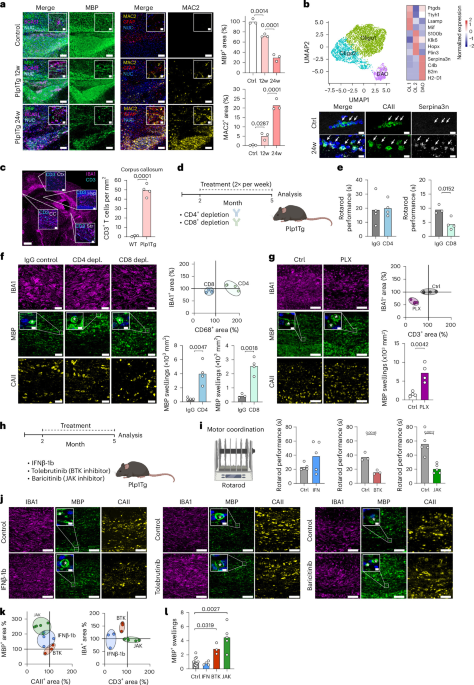
In particular, it is unclear whether chronic injury induces repeated cycling through states resembling those observed during acute demyelination or instead drives distinct and potentially maladaptive cellular programs. We therefore performed comparative analyses of acute and chronic demyelination models, integrating microglial transcriptomic profiling with histological, lipidomic and sterolomic analyses. To investigate immune responses during chronic progressive demyelination, we utilized a mouse model of Pelizaeus–Merzbacher disease (Plp1Tg), which carries extra copies of the wild-type (WT) Plp1 gene25.
Extract — continue reading at the source.


