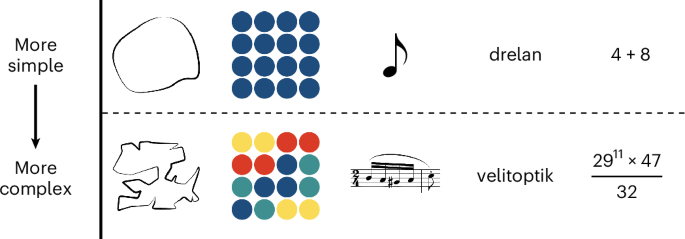
Any information-processing system must deal with the complexity of its input. Yet, complexity arises in many forms: an image may be complex, a melody may be complex, and so too for linguistic or mathematical expressions. Are these disparate forms of complexity ‘unified’ in the mind, such that cognition represents a common quantity shared across qualitatively different types of information?
Here we present 11 experiments (N = 1,500) that reveal domain-general representation of complexity. First, a reward-transfer task revealed that outcomes associated with complexity generalize across diverse stimulus classes, including shapes, dot arrays, melodies, letter strings, mathematical expressions and tactile forms. Subsequent experiments demonstrated that such transfer occurs automatically (intruding on task-irrelevant judgements) and underwrites individual differences in higher-level judgements across domains; for example, participants who find simple shapes aesthetically pleasing also find simple melodies pleasing.
These results implicate a capacity for type-independent representation of information density, consistent with a shared representational language across cognitive domains. This is a preview of subscription content, access via your institution Access Nature and 54 other Nature Portfolio journals Get Nature+, our best-value online-access subscription Receive 12 digital issues and online access to articles Prices may be subject to local taxes which are calculated during checkout All data are available via OSF at https://osf.io/42umv/. All code is available via OSF at https://osf.io/42umv/.
Complexity and the Function of Mind in Nature (Cambridge Univ. Godfrey-Smith, P. in The Evolution of Intelligence (eds Sternberg, R. & Kaufman, J.) 223–249 (Psychology Press, 2013). Physical determinants of the judged complexity of shapes.
Psychol. 53, 221–227 (1957). A., Odijk, D., Honing, H. & Grahn, J. What makes a rhythm complex?
The influence of musical training and accent type on beat perception. PLoS ONE 13, e0190322 (2018). Article PubMed PubMed Central Google Scholar Kolmogorov, A.
Extract — continue reading at the source.


