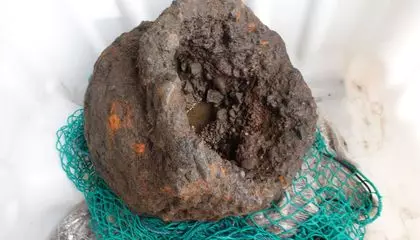
When the divers ducked beneath the surface, they knew their target: a mysterious iron cauldron at the bottom of England’s River Wear. They had no idea how the vessel had ended up there, though they were fairly certain it had been underwater for hundreds of years. Their mission was to recover it from the watery darkness and bring it back to the surface.
The operation unfolded “like clockwork,” Gary Bankhead, an underwater archaeologist at England’s Durham University, tells the Northern Echo’s Andrew White. Everybody had a specific job.” After freeing the artifact from debris, the divers secured it in thick green netting inside a metal cage. Team members on a recovery craft above then slowly pulled it up into the late morning sun.
It arrived back on land for the first time in centuries—but just how much time had passed? Researchers have a few loose theories. The three-legged cauldron was found alongside a trove of ancient Roman artifacts, but its design isn’t consistent with the Roman era.
Experts’ best guess is that it’s medieval. Their second-best guess is that it dates to the Iron Age. The Wear is located near the city of Sunderland in northern England.
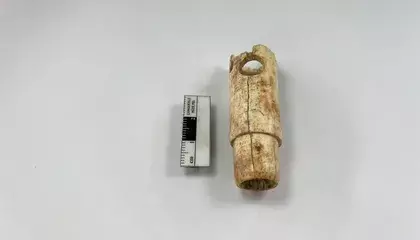
In recent years, volunteers investigating the riverbank have discovered roughly 800 Roman whetstones, which soldiers used to sharpen swords and other tools in antiquity, as well as coins and stone anchors. Researchers analyzed the sediment layer the whetstones were found in to determine their age, according to a statement from Durham University. The sediment samples dated to between 104 and 238 C.E.
Researchers think the site was home to a factory that operated thousands of years ago. England was a Roman province for hundreds of years, beginning in the first century C.E., but Roman-era discoveries are rare in Sunderland. He spotted the cauldron while diving in the river in September 2025.
Extract — continue reading at the source.