Major depressive disorder (MDD) is a highly prevalent psychiatric disorder associated with substantial morbidity and mortality. Despite its prevalence, the neural mechanisms underlying MDD and its treatment remain insufficiently understood, contributing to limited treatment efficacy and trial-and-error clinical practice. Although pretreatment brain signatures have been associated with MDD diagnosis and antidepressant response, the precise neural circuits underlying these associations remain elusive.
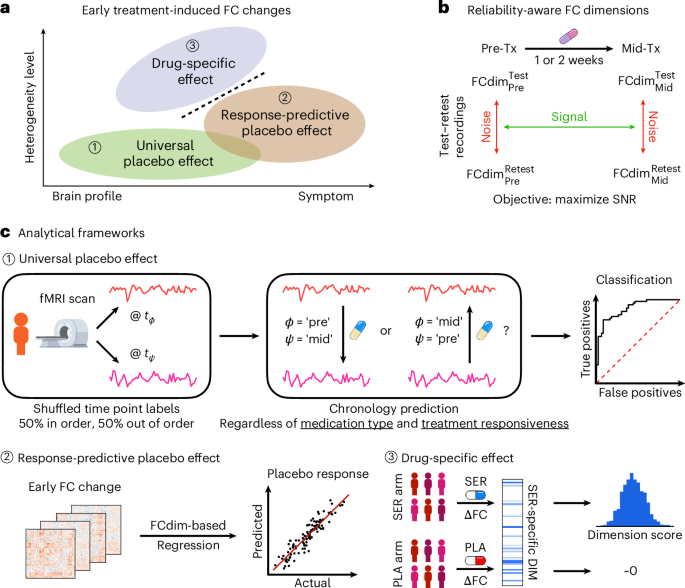
Here, to bridge this gap, we systematically characterize early treatment-induced changes in functional connectivity (FC) following 1 or 2 weeks of antidepressant or placebo administration using two independent cohorts of patients with MDD who are receiving medication (N = 386; 125 placebo, 123 sertraline, 138 escitalopram; 257 female, 129 male; aged 18–65 years). Leveraging innovative predictive and contrastive machine learning frameworks, we identify a visual–precuneus–thalamus system exhibiting increased FC across patients, regardless of treatment or clinical outcome, and implicate striatal and attention networks in mediating placebo-related symptom improvement. Drug-specific effects center on the amygdala, midcingulate, orbitofrontal cortex and cerebellum but are present only in a subset of patients treated with antidepressants; notably, the responses of those without such changes can be predicted with a placebo response prediction model.
These findings reveal generalizable antidepressant-induced early FC changes, parse these changes into constituent placebo and drug-specific effects, and offer mechanistic insights into antidepressant action, supporting the development of interactive treatment optimization for MDD. ClinicalTrials.gov identifier: NCT01407094. This is a preview of subscription content, access via your institution Receive 12 digital issues and online access to articles Prices may be subject to local taxes which are calculated during checkout The EMBARC cohort is publicly available through the National Institute of Mental Health Data Archive (NDA) (https://nda.nih.gov/edit_collection.html?id=2199).
The CAN-BIND-1 cohort is available under a data use agreement with Brain-CODE, based at the Ontario Brain Institute (https://www.braincode.ca/content/canadian-biomarker-integration-network-depression-can-bind-0). The analyses were implemented in MATLAB R2022b, and the code is publicly available via Code Ocean at https://codeocean.com/capsule/0028806. Machine learning in major depression: from classification to treatment outcome prediction.
Ther. 24, 1037–1052 (2018). Article PubMed PubMed Central Google Scholar Bondi, E., Maggioni, E., Brambilla, P. & Delvecchio, G. A systematic review on the potential use of machine learning to classify major depressive disorder from healthy controls using resting state fMRI measures.
Identifying neuroimaging biomarkers of major depressive disorder from cortical hemodynamic responses using machine learning approaches. EBioMedicine 79, 104027 (2022). Functional connectivity signatures of major depressive disorder: machine learning analysis of two multicenter neuroimaging studies.
Extract — continue reading at the source.