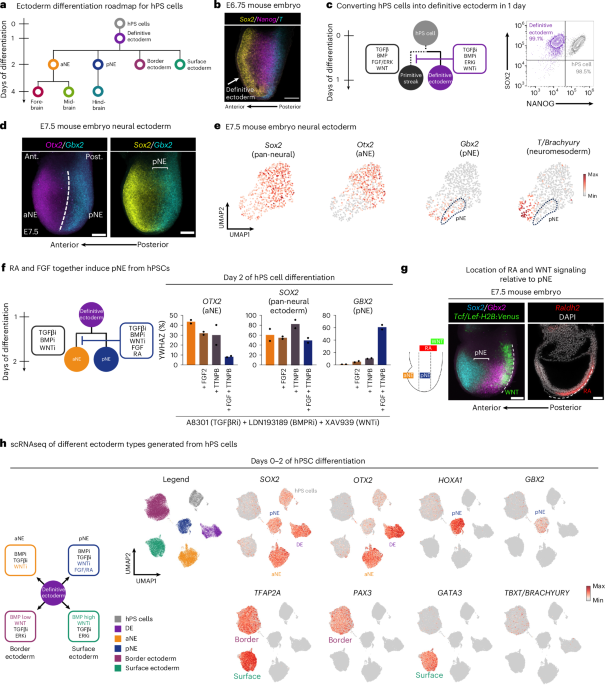
When and how different brain regions diversify from one another remains unresolved. Does a common neural ectoderm progenitor generate the entire brain? Or do multiple neural ectoderm progenitors exist, each restricted to form specific brain regions?
Here our lineage tracing studies of mouse embryos support the latter model. Two parallel brain progenitors emerge simultaneously during gastrulation: anterior neural ectoderm (forebrain/midbrain progenitor) and posterior neural ectoderm (hindbrain progenitor). Differentiation of human pluripotent stem cells into anterior or posterior neural ectoderm-like cells revealed these were lineage committed to forebrain/midbrain versus hindbrain fates, respectively.
They harbored diverging chromatin landscapes foreshadowing future forebrain/midbrain versus hindbrain identities. We further differentiated human pluripotent stem cells into hindbrain rhombomere 5/6-specific motor neurons, which were hitherto difficult to generate in vitro. Hence, we postulate the brain is a composite organ emanating from two lineage-restricted progenitors; these dual progenitors may be evolutionarily conserved across 550 million years from hemichordates to mammals.
This is a preview of subscription content, access via your institution Access Nature and 54 other Nature Portfolio journals Get Nature+, our best-value online-access subscription Receive 12 print issues and online access Prices may be subject to local taxes which are calculated during checkout Bulk-population RNAseq, scRNAseq and OmniATAC-sequencing datasets generated as part of this study are available at the NCBI Gene Expression Omnibus (accession nos. GSE286146 (OmniATAC-sequencing), GSE286147 (bulk RNAseq) and GSE286148 (scRNAseq)). These datasets are grouped under SuperSeries accession no.
An interactive web browser to explore scRNAseq data of the hPS cell-derived cell types generated in this study is available at https://anglohlabs.shinyapps.io/dundes_jokhai_lohlab/. Source data are provided with this paper. Computational scripts used in this study to analyze sequencing datasets are available via GitHub at https://github.com/lohlaboratory/ane-pne.
Constructing the hindbrain: insights from the zebrafish. Dyn. 224, 1–17 https://doi.org/10.1002/dvdy.10086 (2002). Krumlauf, R. & Wilkinson, D.
Extract — continue reading at the source.


