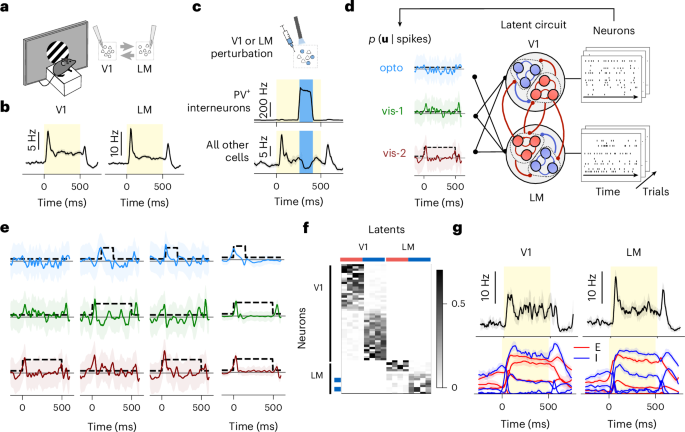
Although computations within individual areas have been well studied, it is unclear how these regions function collectively and reconcile potential conflicts to form coherent percepts and decisions. We investigated the joint dynamics of primary (V1) and higher-order lateromedial (LM) visual areas in mice using simultaneous multi-area electrophysiological recordings along with focal optogenetic perturbations to causally manipulate neural activity. We used data-driven nonlinear system identification to construct biologically constrained latent circuit models of both areas.
This approach revealed that reciprocal excitatory connections between V1 and LM implement an approximate line attractor in their joint dynamics: this selectively slows the decay of congruent activity patterns while accelerating the decay of inconsistent ones, thereby dynamically achieving inter-area consensus. This mechanism predicts different timescales for consistent versus inconsistent activity patterns across areas, which we verified in our data. These findings, together with our mechanistic theory, identify dynamic consensus building as a general principle of distributed cortical computation.
The neocortex is segregated into distinct areas that are specialized for specific functions. This organization allows for decomposing complex problems into simpler subcomputations, such as the extraction of low-level features from intricate visual scenes. However, cognition arises from the holistic integration of these processes, making it essential that the different areas work in concert and remain consistent with each other.
It is unclear how such coordination is achieved and, in particular, how any conflict that might arise between local subunits can be globally resolved. Anatomically, cortical areas are densely interconnected through reciprocal long-range inter-area connections1, whose organization is markedly distinct from that of local circuits within a cortical area. For instance, both excitatory and inhibitory neurons have local innervation, whereas only excitatory neurons have long-range projections that may target other areas (refs. 2,3,4, but see refs. 5,6).
The functional role of these distinct connectivity rules is not clear; it remains unknown how excitatory inter-area connections coordinate cortical activity and unify local subunits into coherent global computations. To address this, we combined mechanistic modeling of cortical circuits with data-driven inference of circuit dynamics. This approach allowed us to build models of cortical activity that not only explained neural responses quantitatively but also captured the causal effects of optogenetic perturbations and had biologically interpretable components, including local and long-range connections, whose functional significance we could interrogate.
We focused on the joint activity dynamics of the V1 and higher-order LM visual areas in mice during visual processing. We used simultaneous multi-channel recordings from V1 and LM performed while mice were presented with a 500-ms-long visual stimulus—one of two stationary gratings oriented at +45° or −45° (Fig. 1a,b). Mice were trained to perform a go/no-go task, discriminating the two stimuli.
Extract — continue reading at the source.