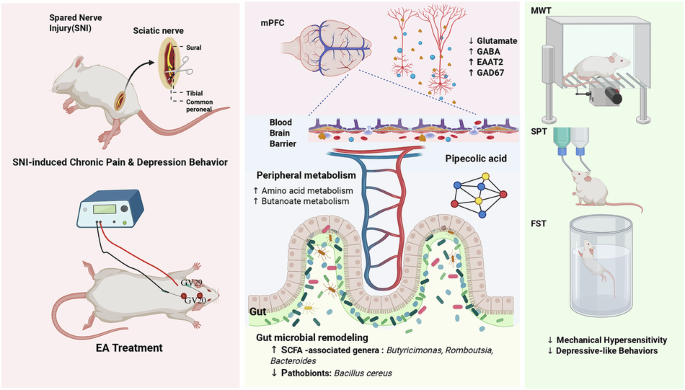
The comorbidity of chronic pain and depression is increasingly recognized as a systemic disorder involving dysregulated microbiota–gut–brain communication. Although electroacupuncture (EA) has demonstrated therapeutic efficacy for both pain and depression, the mechanisms linking peripheral microbial-metabolic remodeling to central neurotransmitter regulation remain incompletely understood. Here, we employed an integrated multi-omics approach in a spared nerve injury (SNI) rat model to investigate the gut–metabolite–brain mechanisms underlying EA’s efficacy.
EA significantly alleviated mechanical hypersensitivity and depressive-like behaviors while restoring mPFC Glu/GABA balance, accompanied by normalization of the glutamate transporter EAAT2 and the GABA-synthesizing enzyme GAD67. Metagenomic analysis showed that EA remodeled the gut microbial ecosystem by increasing microbial diversity, suppressing opportunistic pathobionts, including Bacillus cereus, Alistipes onderdonkii, while enriching SCFA-associated genera, including Butyricimonas and Romboutsia. These alterations were accompanied by coordinated remodeling of amino acid and butanoate metabolism.
Correlation network analysis identified Pipecolic acid as a central metabolic node linking gut microbial alterations with mPFC GABAergic neurotransmission and behavioral recovery. Although individual bacterial genera did not significantly mediate its restoration, causal mediation analysis demonstrated that the Pipecolic acid–GABA axis significantly mediated improvements in both mechanical allodynia and anhedonia, supporting Pipecolic acid as a functional metabolic hub linking peripheral metabolic remodeling to central GABAergic regulation. Collectively, these findings identify peripheral metabolic remodeling as a key mechanistic interface through which EA coordinates gut microbial ecology and central neurochemical homeostasis, providing a systems-level framework for understanding the therapeutic mechanisms of acupuncture in pain–depression comorbidity.
Chronic pain (CP) is a pervasive global health challenge affecting approximately 20% of the adult population, now recognized not merely as a symptom but as a distinct disease entity with complex biological, psychological, and social dimensions [1]. A critical clinical feature of CP is its high comorbidity with psychiatric disorders, particularly depression. Epidemiological studies indicate that 30% to 50% of patients with chronic pain suffer from co-occurring depression, a prevalence rate significantly higher than in the general population [2].
This ‘pain-depression dyad’ forms a vicious cycle of mutual exacerbation, significantly compromising prognosis and increasing disability. Current pharmacological management—relying heavily on opioids, non-steroidal anti-inflammatory drugs, and antidepressants—often yields suboptimal outcomes for this comorbidity and is frequently limited by tolerance, addiction risks, and systemic side effects [1, 3]. Consequently, there is a pressing demand for safe, effective, and well-tolerated non-pharmacological interventions.
The co-occurrence of chronic pain and depression is underpinned by shared neuroplastic maladaptations, particularly within the prefrontal cortex (PFC), a critical hub for pain modulation and emotional processing [4, 5]. It is well-established that the disruption of the PFC Glu/GABA balance precipitates the co-morbid pain and depressive behaviors [6, 7]. However, mounting evidence suggests that these central circuit disruptions are not an isolated event but are dynamically regulated via the bidirectional microbiota–gut–brain axis [8, 9].
Extract — continue reading at the source.