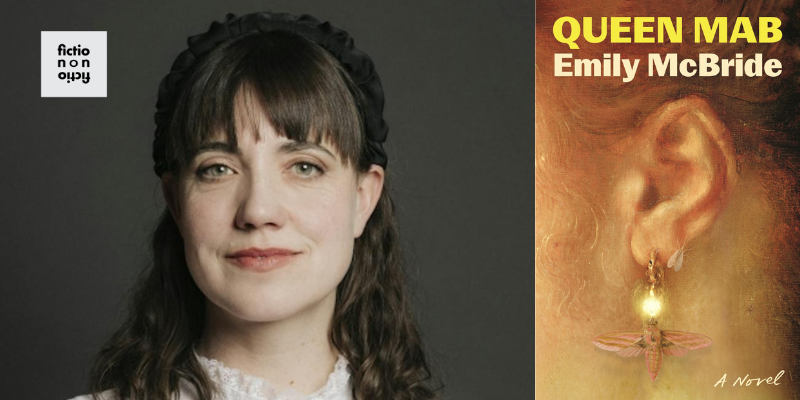
Ganeshananthan and Whitney Terrell to discuss her debut novel, Queen Mab, and maternal mental health. McBride talks about the media frenzy around the trial of Lindsay Clancy, a Massachusetts woman charged with killing her three children, and considers how Clancy’s insanity defense has seized the public imagination, prompting new conversation about postpartum psychosis. McBride reflects on Queen Mab’s protagonist, a 23-year-old graduate student of Victorian and modernist literature, who struggles to bond with her baby and begins to fear that her child is a changeling.
McBride explains the narrative shifts she uses to portray the character’s fluctuating reality and why literary allusions to changelings and fairies make sense in the context of the pressures of new motherhood. She also discusses how the most infamous “bad mothers” in folklore have skewed society’s perception of postnatal depression. She reads from Queen Mab.
To hear the full episode, subscribe through iTunes, Google Play, Stitcher, Spotify, or your favorite podcast app (include the forward slashes when searching). You can also listen by streaming from the player below. Check out video versions of our interviews on the Fiction/Non/Fiction Instagram account, the Fiction/Non/Fiction YouTube Channel, and our show website: https://www.fnfpodcast.net/ This podcast is produced by Whitney Terrell, V.V.
Ganeshananthan, Emily Farris, Sydney Perkins, and Emma Ware. Inferno by Catherine Cho • Lucky Jim By Kingsley Amis • Romeo and Juliet by Shakespeare • The Yellow Wallpaper by Charlotte Perkins Gilman • Madame Bovary by Gustave Flaubert • Medea by Euripides • Labyrinth (1986) dir. by Jim Henson • Cottingley Fairies: How Sherlock Holmes’s creator was fooled by hoax | BBC (2020) EXCERPT FROM A CONVERSATION WITH EMILY MCBRIDE V.V. Ganeshananthan: Another complexity of Madeleine’s backstory is that she’s adopted.
She makes an unsuccessful attempt to learn the identity of her birth parents, and that changes her relationship to her mother Carol, and she explains this out loud one night to her infant daughter. I wonder if you could talk a little bit about the role Carol plays in the book. Emily McBride: By the time I was writing this book I had two children myself, and I was aware that there was a lot of conversation happening among my age group about motherhood and whether it was something people wanted to do or needed to do.
I wanted to expand the canvas a little bit to include other experiences and not just people who have decided to have children, and have them. So in this book, there’s people that wish to have children and don’t, people who don’t wish to have children and do, people who don’t want and don’t have, and all the combinations basically. And so Carol is the second face of the coin that is Madeleine.
Extract — continue reading at the source.