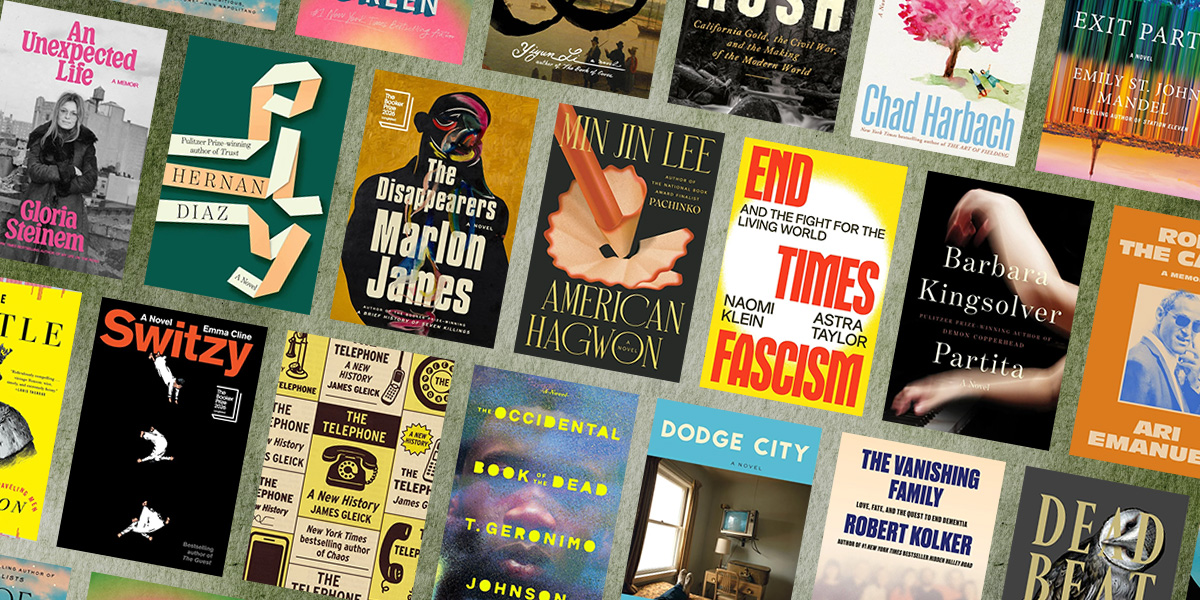
Station Eleven (2014), which won the Prix des Libraires du Québec, the Arthur C. Clarke Award, the Toronto Book Award and was a finalist for the National Book Award and the PEN/Faulkner, takes place before, during, and after a fiercely contagious flu wipes out 99 percent of the world’s population. Sea of Tranquility (2022), which she described to me once as “autofiction through a sci-fi lens combined with time travel,” spans five centuries, beginning in 1912, with a pandemic wiping out Earth’s population (it was written during the COVID pandemic).
In her new novel, Exit Party, the dystopia is political. The year is 2031.“The United States had come undone following a coup d’etat,” she writes. In our last conversation, Mandel mentioned that she was working on “a new novel that has characters from two of my previous books.” And here it is; what motivated you to write Exit Party?
There were a couple of starting points for this novel. One is that years after publishing my second novel, The Singer’s Gun, I remained fascinated by a character from that book, Ari. I found myself wondering what she’d be like after a very long prison sentence, and I wanted to write about her again.
I started writing this novel in the spring of 2022, not long before I spoke with you, and the country was only slightly less fractured then than it is now. We were already seeing the effects on our politics of years of successful disinformation campaigns. It unfortunately doesn’t take a wild leap of speculative imagination to imagine the country breaking apart, and I was interested in what the aftermath of a national collapse could look like.
I’ve never been particularly interested in disaster, but I am interested in its aftermath. There’s hope in thinking about the world that follows catastrophic events.” Jane Ciabattari: Exit Party’s cast of characters includes Ari Waker, the villain who blackmails her cousin and partner in crime Anton Waker, the central character in The Singer’s Gun (2015). Elsewhere in the novel, we meet Lucas Alkaitis, the painter from The Glass Hotel.
What drew you back to Ari and Anton, and to Lucas? John Mandel: This isn’t a spoiler, because it’s literally the plot of a novel I published in 2010, but one of the defining events of Ari’s life is her decision to take out a contract on her cousin Anton. So as I mentioned, I’d wanted to write about Ari again, and I felt like there was some emotional calculus where bringing Ari into this book required bringing Anton into the book too.
Extract — continue reading at the source.