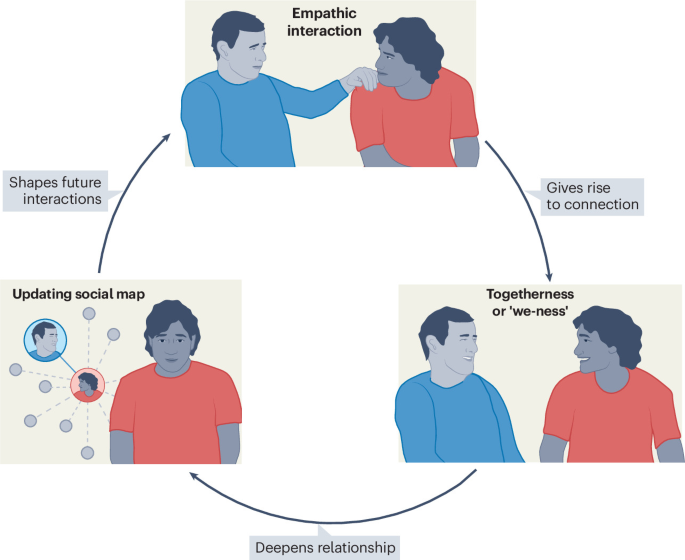
Empathy lies at the core of human social life and shapes interpersonal understanding, cooperation and psychological well-being. Traditionally, empathy research has focused on the empathizer: the individual who experiences and expresses empathy towards another person or group. However, a growing body of work suggests that empathy is best understood within a dyadic process that is shaped by both partners over the course of an exchange.
In this Review, we conceptualize empathic interaction as a shared, ongoing, dyadic process that involves an empathizer, a recipient (target) and a jointly constituted experience that can foster positivity resonance and togetherness. We consider the cognitive, affective and motivational aspects of empathy through a dyadic lens. In doing so, we clarify how each component manifests for both empathizers and recipients, and how partners’ reciprocal cues, interpretations and responses dynamically influence one another across these components.
We conclude by outlining key gaps for future research, including moving beyond stranger-based paradigms to test dyadic mechanisms across relationship types and emotional valence, and leveraging longitudinal, process-sensitive designs to examine whether and how empathic interactions change across relationship development. This is a preview of subscription content, access via your institution Receive 12 digital issues and online access to articles Prices may be subject to local taxes which are calculated during checkout Depow, G. J., Francis, Z. & Inzlicht, M.
The experience of empathy in everyday life. Sci. 32, 1198–1213 (2021). Article PubMed PubMed Central Google Scholar Delgado, M.
Characterizing the mechanisms of social connection. Neuron 111, 3911–3925 (2023). Stronger empathy and better peer relationship?
One-year cross-lagged panel analysis in preschoolers. C., Makati, R., Jackson, M. Empathy and well-being correlate with centrality in different social networks.
Extract — continue reading at the source.


