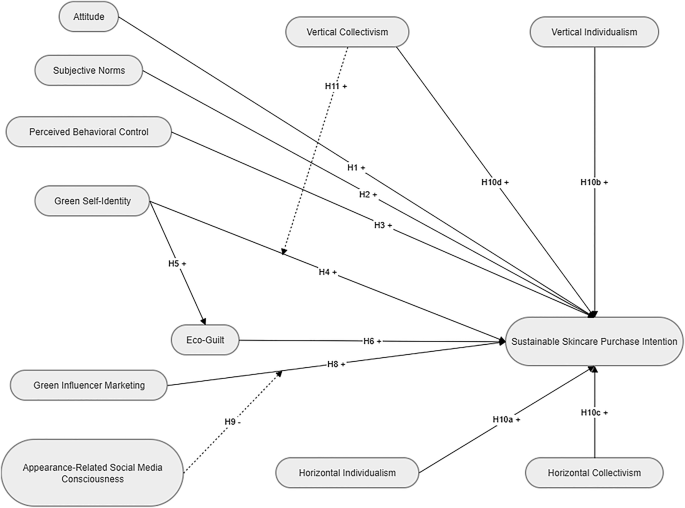
This study explains why Generation Z consumers in Arab markets form intentions to purchase sustainable skincare products and clarifies the psychological mechanism through which green self-identities are converted into intention. Extending the Theory of Planned Behavior with constructs derived from value-belief-norm theorizing (green self-identity and eco-guilt), a Green Influencer Marketing (GIM) construct measured with a validated eight-item scale and modelled as a single reflective composite, appearance-related social media consciousness, and the horizontal-vertical individualism-collectivism framework, the study positions eco-guilt as the mediating mechanism and appearance-related social media consciousness and vertical collectivism as moderating boundary conditions. Data were collected in January 2026 through an online survey of Generation Z consumers in Egypt, Saudi Arabia, the United Arab Emirates, and Qatar; after screening and the exclusion of fifteen underage respondents, 369 adult responses (ages 18 to 29) were analyzed using partial least squares structural equation modeling in SmartPLS 4 with 10,000 percentile bootstrap subsamples.
The findings show that the model explains 78.3% of the variance in purchase intention with strong out-of-sample predictive relevance (Q²predict = 0.734). Attitude, eco-guilt, GIM, vertical collectivism, horizontal individualism, and vertical individualism exert significant positive effects, whereas subjective norms exert a significant negative effect and perceived behavioral control and horizontal collectivism are non-significant. Green self-identity influences intention entirely indirectly through eco-guilt (indirect effect = 0.159, 95% CI [0.100, 0.219]), appearance-related social media consciousness attenuates the GIM effect, and vertical collectivism strengthens the identity-intention link.
The pattern is consistent with identity-based sustainability dispositions requiring moral-emotional activation and with cultural hierarchy licensing their behavioural expression, although the cross-sectional design does not permit causal inference. Theoretically, the study clarifies the mechanism connecting self-identities to intention and identifies two boundary conditions of digital and cultural origin; practically, it directs sustainable beauty brands toward moral-emotional framing, relational rather than appearance-centric green influencer strategies, and family- and duty-anchored positioning in Arab markets. The beauty industry presents a unique paradox in an industry already rife with paradoxes.
Beauty products are widely associated with environmental concerns, particularly the plastic and petrochemical packaging waste their consumption generates. Beauty’s association with self-care makes it an especially difficult problem to tackle for the many young consumers concerned with sustainability. Gen-Z has been theorized to have the ability to tackle this paradox for the beauty industry and beyond.
Gen-Z’s strong concern for sustainability and greater willingness to pay for ethical products compared to previous generations has been documented, for example, by Becerra et al.1. However, this expressed concern does not consistently translate into corresponding purchases, reflecting the well-documented gap between sustainability attitudes and actual green-purchase behavior1,2. The persistence of the paradox is especially troublesome for the Theory of Planned Behavior (TPB)3 as it accounts for positive attitudes, supportive environmental norms of the community, and a perception of the ability to reach the goal, yet still produces no intention or behavior to do so.
This study is motivated by three gaps that will be described at different levels of analysis. The first is a theoretical gap. Literature that combines identity and moral constructs into the Theory of Planned Behavior (TPB) is extensive, and the cognitive pathway from these constructs to intention is still unclear.
Extract — continue reading at the source.


