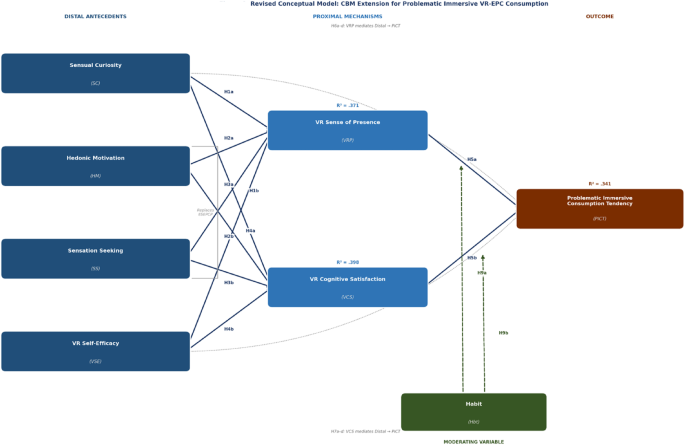
Existing cognitive-behavioral accounts of problematic technology use were developed for screen-based media and do not incorporate the distinctive immersive affordances of virtual reality (VR). Drawing on the Cognitive-Behavioral Model, this study tests an extended model in which four distal antecedents, sensual curiosity (SC), hedonic motivation (HM), sensation seeking (SS), and VR self-efficacy (VSE), predict problematic immersive consumption tendency (PICT) via two VR-specific proximal mechanisms: VR sense of presence (VRP) and VR cognitive satisfaction (VCS). Habit (Hbt) is theorized as a boundary condition.
PICT is operationalized using an expanded six-item measure grounded in Griffiths (2005) components model, advancing prior three-item instruments. Structural equation modelling on survey data from 380 active VR-EPC consumers, with bootstrapped mediation (5000 resamples) and hierarchical moderation regression, yields the following results: HM is the strongest predictor of VRP (β = 0.318) and VCS (β = 0.481); VCS is the stronger proximal predictor of PICT (β = 0.291) relative to VRP (β = 0.228); all eight indirect mediation paths are significant; habit is associated with a small but statistically significant amplification of the VRP-PICT relationship (β = 0.116, ΔR2 = 0.018) but not VCS-PICT (β = 0.031). Discriminant validity is confirmed via Fornell–Larcker and HTMT (Heterotrait-Monotrait ratio of correlations) criteria (all HTMT < 0.58).
These findings suggest that VR presence and VCS are distinct proximal pathways linking motivational predispositions to problematic immersive consumption in VR-EPC use, offering preliminary evidence consistent with an immersive extension of CBM and carrying implications for platform design, clinical intervention, and policy. All findings should be interpreted with the cross-sectional design in mind. Virtual reality (VR) creates a pervasive subjective sense of “being there” within a computer-generated three-dimensional world1.
Unlike any prior media format, VR replaces the observer stance of screen-based consumption with an embodied, first-person participatory experience, a shift with potentially consequential psychological implications for how users engage with, and are affected by, mediated content. The consumption of erotic/pornographic content (EPC) in VR exemplifies these implications: VR-EPC users inhabit erotic scenarios from within rather than observing them from outside, creating a qualitatively richer and more psychologically immediate experience than equivalent two-dimensional formats2. Whether and how this immersive shift intensifies the risk of problematic, loss-of-control consumption patterns is an open empirical and theoretical question.
Existing theoretical accounts of digital media addiction were developed primarily for text-based internet use and screen-based media3,4. These frameworks identify maladaptive cognitions and proximal reinforcement experiences as drivers of compulsive use. Still, they do not incorporate the distinctive properties of immersive VR, properties that theory and emerging evidence suggest may intensify both the hedonic appeal and the problematic potential of EPC consumption2,5.
While Saneinia et al.6 applied a cognitive-behavioral framework with VR presence as a mediator in a VR tourism context, no prior study has extended this logic specifically to VR-based erotic content consumption, theorized the asymmetric role of habit across distinct proximal pathways, or proposed and tested a theoretically grounded multi-component PICT measure in this domain. A study by Ahmad et al.7 develops the Immersive Gratification Model (IGM) using the same proximal constructs (VRP, VCS) and habit moderator within a uses-and-gratifications and dual-process framework, predicting compulsive VR-EPC engagement (VRA) from sensual curiosity, VR self-efficacy, and ESEPCP. The present paper is theoretically distinct in two respects: it grounds the antecedent-to-compulsion pathway explicitly in the Cognitive-Behavioral Model (CBM) of problematic Internet use3,8 rather than U&G/dual-process theory, and it introduces and validates the PICT scale as a multidimensional, Griffiths-component-based measure of problematic immersive consumption tendency, in contrast to the VRA single-construct compulsion indicator used in Ahmad et al.7.
Extract — continue reading at the source.


