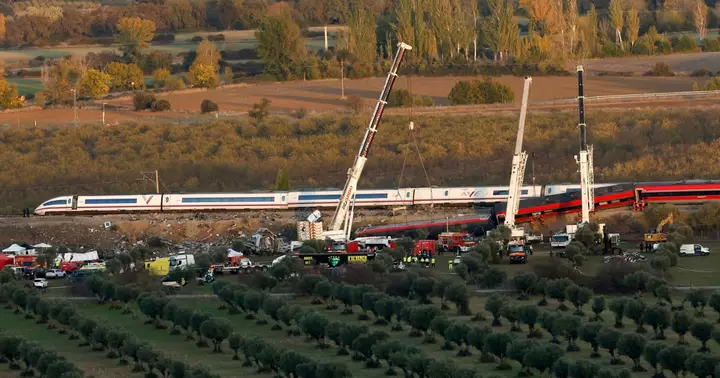
For decades, Spain’s high-speed rail network had been a source of national pride, symbolizing the country’s rapid modernization and its rise among Europe’s leading economies. But Wednesday’s deadly train disaster — following another mass-casualty rail crash in January — is turning that legacy into a political liability and putting the state of the railways at the center of the campaign ahead of the Nov. 29 snap election. Experts point to human error, maintenance issues, austerity and EU-level rail safety reform as all having played their part in the deaths of at least 69 people near Toledo on Wednesday.
Spain’s transport ministry says the preliminary investigation points to a chain of failures. After a computer malfunction knocked out the German-made signaling system installed in 1992, railway network officials took control and authorized a train to proceed along a track where another had stopped, causing the deadly collision. Jaime Tamarit, a former director of a European railway-signaling certification laboratory who helped oversee the development of the pan-European system meant to prevent railway accidents, said the system failure revealed the grave state of Spain’s high-speed rail network.
Although spending has since recovered, it remains well below its pre-crisis level in real terms. Between 2018 and 2022, Spain allocated an average of €1.5 billion a year to high-speed rail —more than France or Germany — but most of that money went toward new infrastructure. Maintenance, renewals and upgrades accounted for about 16% of Spain’s high-speed rail spending, compared with 34% to 39% in France, Germany and Italy, according to European Commission data.
The safety expert attributed the apparent lack of investment to political prioritization that values flashy new construction over maintaining existing infrastructure. Adif, Spain’s railway infrastructure manager, has repeatedly defended the adequacy of its maintenance regime and insists it has always complied with safety requirements. The state-owned company did not immediately respond to a request for comment.
Ana Miranda, a European Parliament lawmaker from Galicia’s nationalist BNG party, accused Spanish authorities of failing to learn from past rail disasters, drawing parallels between Wednesday’s crash near Toledo and the 2013 Angrois disaster in Galicia, which killed 80 people and injured 152. The European Commission subsequently launched infringement proceedings over wider shortcomings in Spain’s railway safety oversight. Miranda said authorities had also failed to conduct a sufficiently rigorous inquiry into January’s Adamuz crash, which killed 46 people.
An independent technical investigator assisting the probe has alleged that Adif altered accident reports, while questions have also emerged over documentation relating to inspections of track welds on the stretch where the crash occurred. Adif denies wrongdoing and says it has cooperated with the judicial investigation. For Miranda, the repeated controversies point to a failure spanning successive governments.
Extract — continue reading at the source.