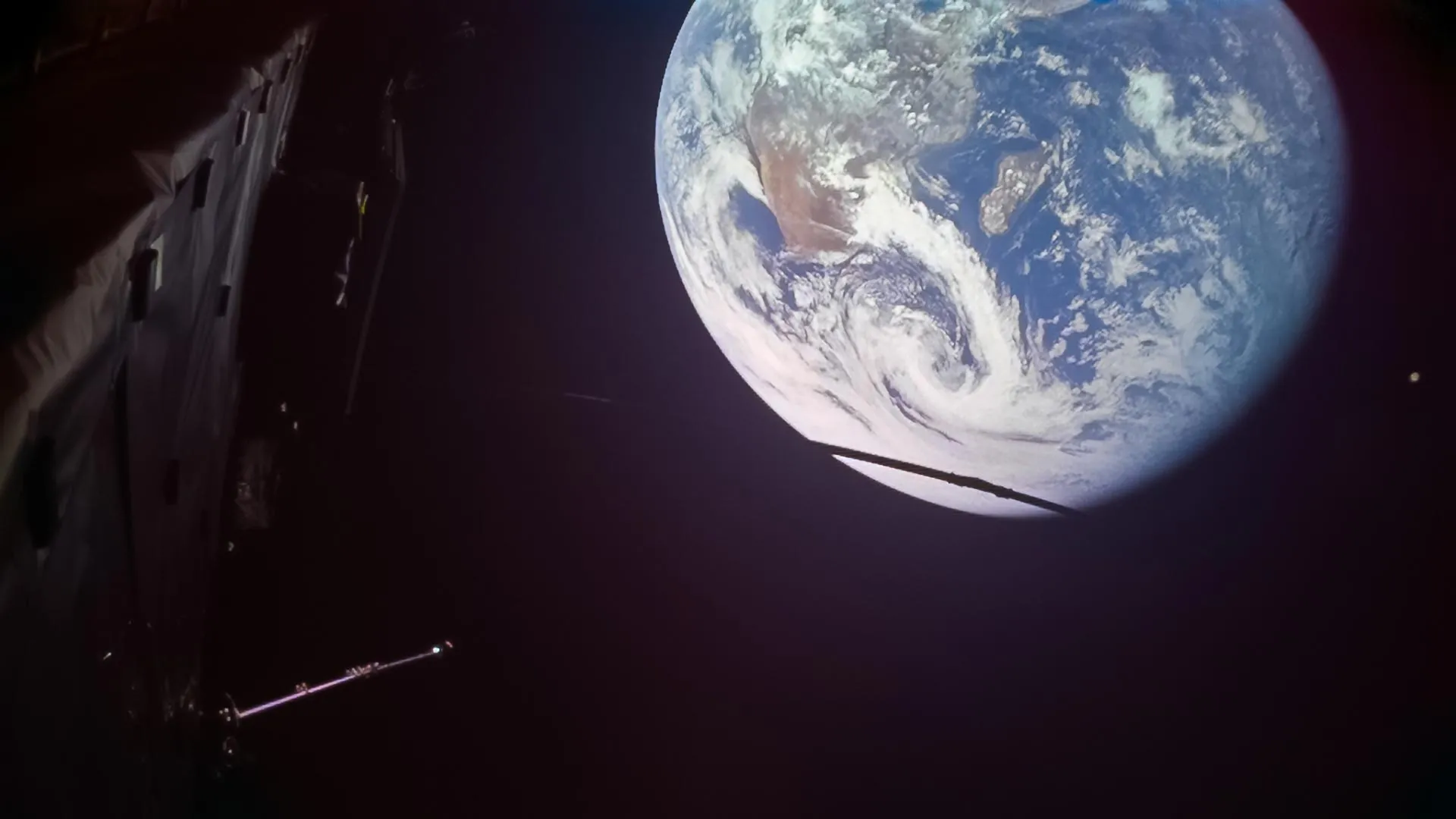
The Artemis II astronauts are on the final leg of their journey home after conducting a historic lunar fly-by, which took them further from Earth than any humans have ever been. As planned, the four-person crew did not land on the Moon but their mission sets the stage for a future human landing for the first time since the 1960s and 70s. The astronauts are due to splashdown in the Pacific Ocean off the west coast of the US at 20:07 eastern US time on Friday 10 April ( Saturday 11 April).
The Orion space capsule is crewed by four astronauts: Americans Reid Wiseman, Victor Glover, Christina Koch and Canadian Jeremy Hansen. The 10-day mission launched on 1 April at 18:35 CDT ( ) after a delay caused by a range of technical issues. These included problems with both the flight termination system - designed to destroy the rocket if it goes off course - and a battery for the launch abort system, which would pull the crew capsule away from danger in case of an issue.
Astronauts shared their pre-launch messages from inside the Orion crew capsule during the 10-minute countdown to lift off. "We are going for all humanity," said mission specialist Hansen. Cheers erupted among jubilant crowds gathered outside the Kennedy Space Center, as Nasa technicians monitored the ascent.
Observers also watched as various milestones were achieved, like seeing the twin rocket boosters separate from the rocket after helping it reach a speed of more than 10,000mph (16,100km/h) Once Artemis II entered the upper atmosphere, Orion commander Wiseman declared it was a "great view". The crew officially entered orbit when they crossed the Kármán line – the boundary between Earth's atmosphere and space. After launch, there was a short-lived comms issue, which meant ground control could not hear the astronauts.
A temporary problem with the toilet was also fixed. During the mission, the astronauts are testing how Orion handles. This involves manually flying the capsule in Earth orbit to practise steering and lining up the spacecraft for future Moon landings.
They are also checking the spacecraft's life‑support, propulsion, power and navigation systems. Orion reached its maximum distance from Earth - 252,756 miles (406,771km) - during the lunar fly-by. The crew had already broken the previous record for the furthest distance humans have travelled into space.
Extract — continue reading at the source.