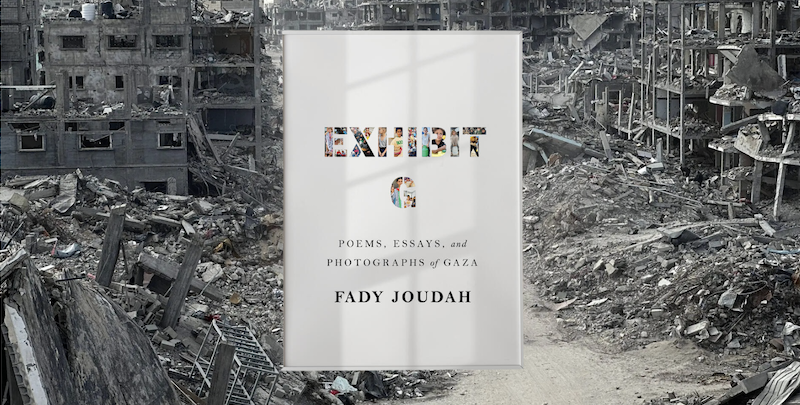
The multimedia poetry collection—assembled in the diaspora, and yet, across form, content, and voice, never anywhere but Gaza—charts Palestinian life under genocide. Exhibit G continues Joudah’s poetic meditation on language and time, the basic structural forces of life, stripped of stability under genocide. Where Joudah’s […] (2024) dwelt in silence and its residues, Exhibit G constitutes the utterance ultimately yielded by the refusal of certain speech.
Confronted with the impossibility of ensuring its people’s survival tomorrow, the “Exhibit” assumes a polyphonic form in the language of Gaza. A collaboration among Joudah—a Palestinian physician and poet from Gaza, based in Houston, Texas—Palestinian poets writing from and about Gaza, and the Gaza Soup Kitchen alongside the Gazan photographers documenting its work, the collection answers the need for a renewed poetics as Palestine struggles to endure in English and Arabic alike. Moving across poems, essays, photographs, and drawings, Exhibit G gathers the many hands, faces, and odes of a people feeding, burying, and naming itself as the US-Israeli genocide persists, unrelenting, from the 1948 Nakba to its present horrors.
Joudah sits with a single letter—“G”—that lingers on the tongue in the moment before utterance. The “G” of genocide, the “G” of Gaza in English, becomes here a disinterred horizon, a grammar of ghurbah (Arabic for exile or alienation) and ghurūb (Arabic for setting or decline). The sun rises and sets ceaselessly in the West; its light refuses Palestinian shores, the visible landscape and its accompanying clock forced into another reality of perpetual darkness.
Neither a museum nor an exhibition nor a criminal case document, Exhibit G highlights Gaza’s unceasing endurance, counter to the fleeting “exhibit” that has been made of Palestinian suffering under the Western sun. The result is a formidable journey through committed verse necessarily without a clear exit for the reader. In the reality of genocide, Joudah and his interlocutors construct a Palestinian poetry through the ceaseless demands of stable time, lineage, and language, now destroyed.
Labīd—at the beginning of our Arabic poetic heritage—reminds us that time, still, is always at hand. For the war of empires, the battle of time between “pre-” and “post-”, has been ours since before we knew it: دِمَنٌ تَجَرَّمَ بَعدَ عَهدِ أَنيسِها حِجَجٌ خَلَونَ حَلالُها وَحَرامُها Dark and dirt-trodden now lie their grounds, their people, gone with years past, months both sacred and profane. Joudah, indeed, walks along a timeline similarly disfigured by its own passage.
Between the Arabic of Palestine and his English in the United States, Fady Joudah tells us that he cannot “turn off time” as it courses through Exhibit G. The dirt of Labīd’s ode, in its years, struggles to speak through the broken West’s enforced silence: Because no oxygen for the dead. Then they came for the dirt, and the dirt had no lips, so they tossed our corpses in the street The “never” of Joudah’s title maintains its crevices in this Exhibit, into which the people and months, sacred and together, enter.
Extract — continue reading at the source.