A proportional elective system, in which a political party earns representation based on the percentage of votes it receives rather than the first-past-the-post winner-take-all system, ensures that a wide variety of beliefs will have a voice. To elect government leaders, the different parties form coalitions in the absence of an outright majority. In a closely divided government, the smallest parties, whose few votes could determine the majority, wield power far greater than their electoral support would indicate.
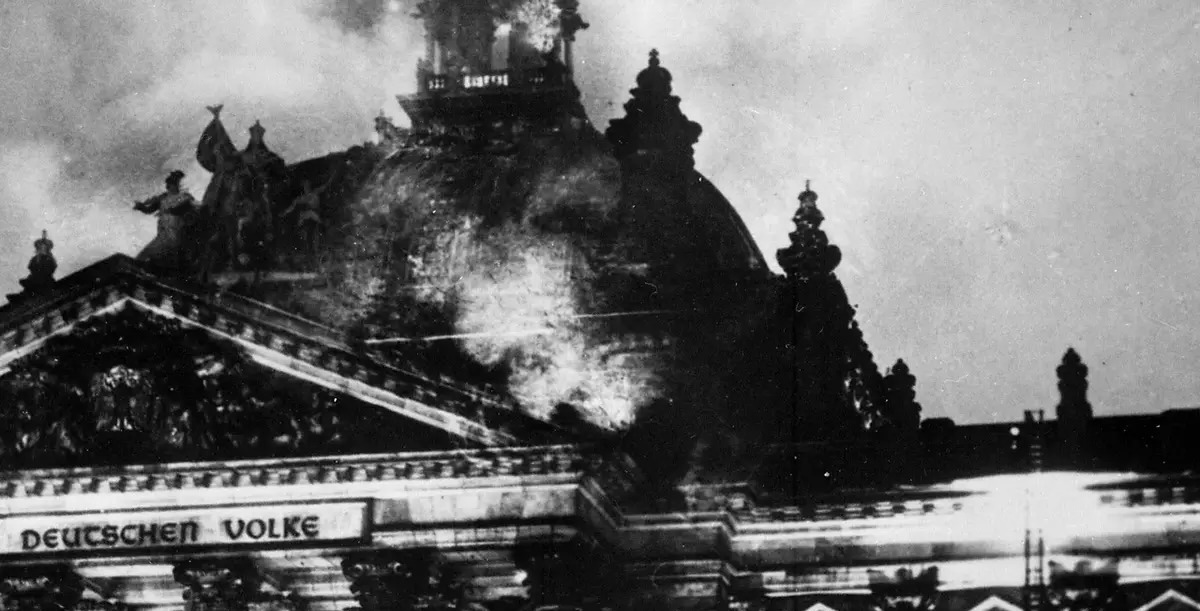
It also ensures that numerous parties with different ideologies will be competing for votes. While in theory this system might seem to be the purest form of representative democracy, in practice it has often led to fragmented or unstable governments, weakened by a continuous shifting in the combinations of ruling parties. In the Weimar Republic, for example, at various times more than forty different political parties won seats in the Reichstag.
Among them were Ebert’s liberal Social Democratic Party (SDP), the moderate Centre Party, the Communist Party (KPD), and the far-right German Workers’ Party, which evolved into the National Socialist German Workers’ Party. The party was originally formed in 1919 by a small group of men, among them a locksmith and a sportswriter, established to appeal to middle-class workers alienated by the terms imposed on the nation by the Treaty of Versailles and suffering from the inability of the Weimar government to stabilize the economy. Rather than supporting democratic reforms, from the beginning it adopted anti-government, anti-Communist, and anti-Semitic policies.
Its weekly meetings were held in the back of a beer hall in Munich. The German Army, alarmed by the Communist leanings of some of the small parties that had sprung up, assigned soldiers to attend their meetings and submit reports. In September 1919, war veteran Corporal Adolf Hitler was sent to monitor the right-wing Workers’ Party.
Hitler had been born in Austria-Hungary. After being rejected by an art school in Vienna, he earned a meager living selling small watercolors and drawings. To escape compulsory military service, he had moved to Munich, but when the Great War began, he enlisted and served on the Western Front, where he was wounded.
When assigned to report on the meetings in the beer hall, he finally found a place he belonged. He embraced the party’s radical, anti-Semitic policies, which fit perfectly with his own racist, ultranationalistic views. He became the fifty-fifth member of the party.
Extract — continue reading at the source.