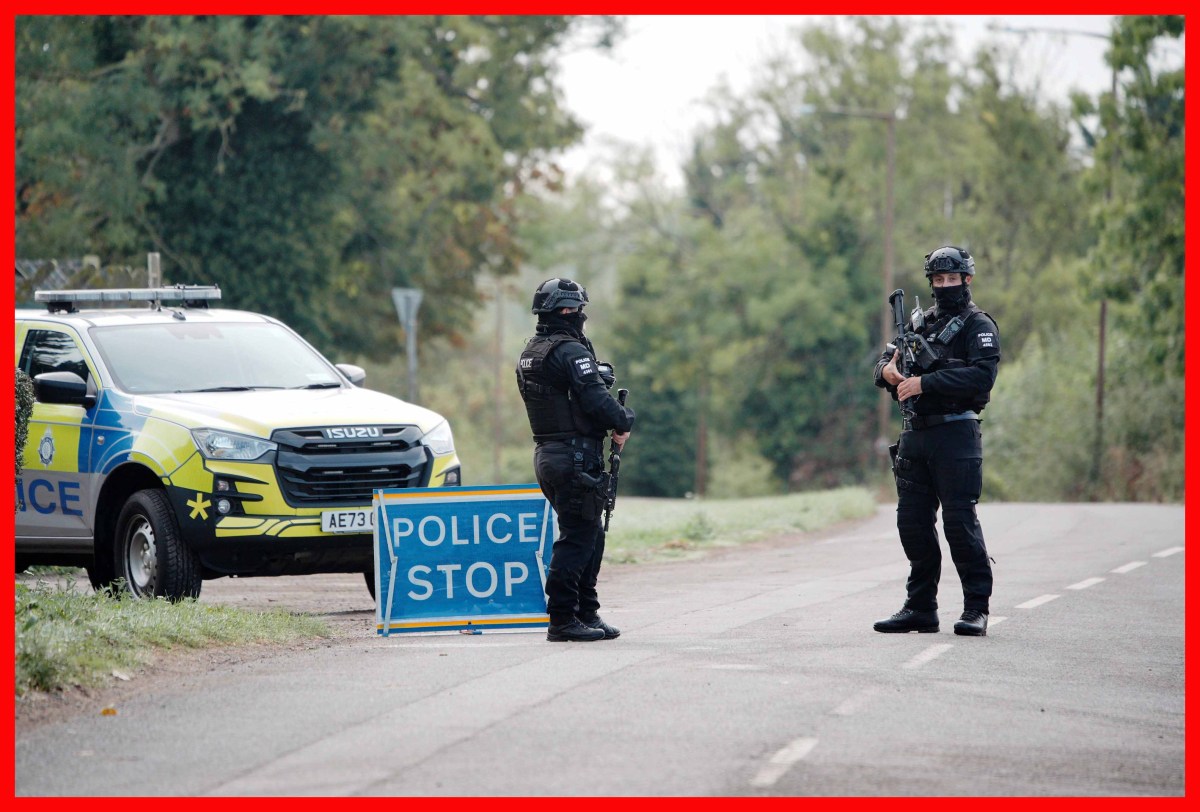
The precise sequence of events remains under investigation, but here is what we know so far: a local farmer said she encountered three vans obstructing a road near the base, then saw a group of hooded and masked men nearby and called 999 at 1:36 a.m. Officers arrived within about 10 to 15 minutes, she said. Gloucestershire Police said officers had already received a call at about 12:45 a.m. on September 27 concerning three suspicious vehicles traveling toward RAF Fairford.
Armed officers later arrested five men in the nearby Whelford area on suspicion of explosives offenses, and Counter Terrorism Policing subsequently said they were also arrested on suspicion of preparing a terrorist act. The details are still hazy and, thanking the farmer for doing what officials would want a member of the public to do, Defense Secretary Wes Streeting said she only had a “partial picture” of events. That's an important caveat because the evidence available so far does not establish that one civilian single-handedly uncovered or stopped a terrorist attack.
But Fairford highlights a more durable picture: even around a sensitive military installation, with layers of intelligence, policing and physical security, the system can still depend on someone outside it to recognize an anomaly and report it. As they've been asking to do for over two decades: if you see something, say something. Fairford is not an isolated argument for keeping the public in the counterterrorism loop.
The British government’s 2023 counterterrorism strategy said police received more than 13,000 reports from the public in a single year, nearly 2,000 of which provided useful intelligence. The government described the public as a “key partner” in preventing attacks and said its role was becoming increasingly important as detecting potential terrorists becomes more difficult. American research points in the same direction.
A 2019 FBI study examined 52 lone-offender terrorist attacks in the United States between 1972 and 2015. In every case, bystanders had expressed concern about the offender’s behavior before the attack. In 25 percent of the cases, at least one other person had become aware of the offender’s research, planning or preparation.
Those numbers help explain why such an apparently low-tech idea survived the extraordinary technological and institutional buildup after 9/11. They point to a problem technology cannot entirely solve: potentially important information often first exists outside government systems, in the observations of neighbors, relatives, co-workers or, as at Fairford, someone who happens to notice that something around them does not look right. After 9/11, the United States expanded law-enforcement and intelligence powers through the Patriot Act, created the Department of Homeland Security by combining 22 agencies and offices, and overhauled intelligence sharing after the 9/11 Commission identified serious failures in how agencies processed and exchanged information, calling for a shift from “need to know” to “need to share.” The result, 25 years later, is a counterterrorism system vastly more elaborate than the one that existed on September 10, 2001.
Extract — continue reading at the source.