In the 1980s, the Indian Forestry Service was facing a deadly problem. Bengal tigers living in a nature preserve were stalking fisherman, honey collectors, and wood cutters, attacking them from behind and killing them. A student, who was inspired by the artificial eyespots insects evolved to ward off predators, came up with a possible solution: a rubber mask worn on the back of the head.
Because the tigers only attacked from behind, the thinking went, they might be deterred by a pair of eyes watching them. So the forestry service handed out thousands of cheap rubber masks. Remarkably, the subterfuge worked (at least for a while).
Now, according to a new study, the same principle could help keep seabirds from entangling themselves in fishing nets. Every year, 95,000 diving seabirds get caught in gillnets off the coast of Europe. These nets stand vertically in the water and snag fish by their gills, which proves to be too tempting for hungry auks (guillemots and razorbills), and they often get entangled and drown.
This collateral damage is euphemistically referred to as “bycatch,” and it gets worse for the birds in winter months when fisheries reduce the size of their net holes. A group of British ecologists led by a team from the University of Exeter studied two different approaches to preventing bycatch. The first, a “scarybird kite,” is marketed to farmers to prevent birds from feeding on their crops.
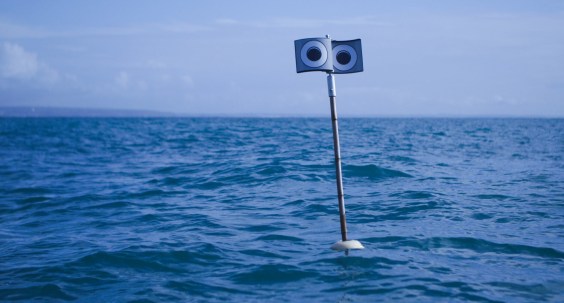
The team also developed their own (decidedly low-tech) deterrence—a floating scarecrow consisting of a pair of giant cartoon eyes attached to a buoy. They tested the pair over a two-year period in the seas surrounding Cornwall. The kite, they found, had plenty of advantages.
Bycatch plunged where it was flown, but only in areas immediately surrounding its path (around 100 feet). On the other hand, the “looming eye buoy” (as they called it) had a much greater range, which resulted in a greater overall reduction of snared birds. Subscribe to our free newsletter.
Extract — continue reading at the source.