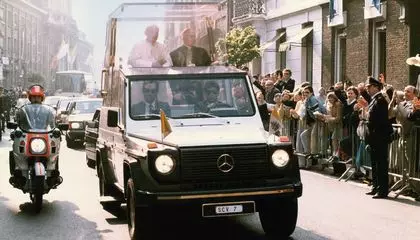
Once dubbed a “sardine can” by Pope Francis, the popemobile—with its large, domed top and bulletproof glass—is truly the only vehicle of its kind on the road. Now, the story of how the fishbowl-esque automobile came to be is on display at the Vatican for visitors from around the world to see. Versions of the popemobile made by other auto companies, like Land Rover, Fiat and Ferrari are not included in the collection.
Unlike the hulking, glass popemobiles of today, this first custom-made model featured a black exterior and a red armchair upholstered in a silk brocade. When Pius XI first took the 80-horsepower car for a spin around the Vatican Gardens, he reportedly cried out: “Beautiful car! A masterpiece … A wonder of modern technology!” The 460 Nürburg and its immediate successors, however, tended to reside in the papal garage.
Popemobiles began incorporating bulletproof glass a year later, after an attempted assassination of Pope John Paul II while he was riding in an open-topped Fiat popemobile. Designing papal automobiles comes with manifold security considerations. When Pope Francis visited the United States in 2015, he rode around Washington, D.C., New York and Philadelphia in a tricked out Jeep Wrangler with open sides and rear seating.
The popemobile has also reflected the distinct preferences of the popes themselves. In 2024, Mercedes-Benz gifted the environmentally minded Pope Francis the first electric car in the popemobile fleet. In fact, Pope Leo XIV referenced this gift, and Pope Francis’ call to make the automotive sector more sustainable, in his address to the Mercedes-Benz executives: “In this spirit, I encourage you to continue placing technological innovation at the service of human dignity, care for creation and the common good.” “A Century of the Popemobile” is on view at the Vatican Museums.
Extract — continue reading at the source.