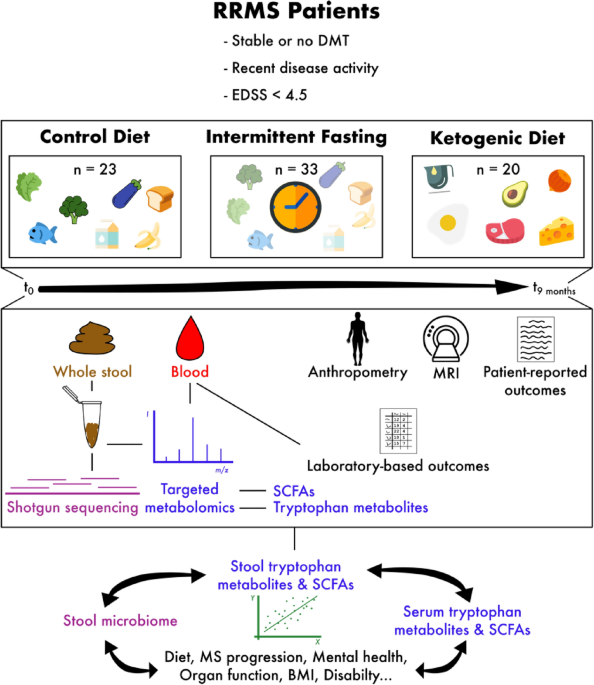
Multiple sclerosis (MS) is a chronic immune-mediated disease of the central nervous system. While disease-modifying therapies can reduce relapse rates, their limitations have spurred interest in adjunctive approaches such as fasting and ketogenic diets (FD, KD). In a randomized controlled trial, participants with relapsing–remitting MS followed FD, KD, or a control diet for 9 months, with multi-omic and clinical assessments.
Our secondary analysis revealed that KD was associated with distinct gut microbial functional profiles, including enrichment of carbohydrate metabolism modules that co-occurred with lower T2 lesion volume. Stool propionate levels, however, did not correspond to the abundance of the annotated propionate production II module. Key contributors included Romboutsia timonensis, Roseburia intestinalis, and Bacteroides thetaiotaomicron.
These microbial changes coincided with diet-associated changes in circulating tryptophan and indole metabolites, suggesting a system-level co-occurrence of changes along the gut-brain axis. We present evidence that KD is associated with coordinated tryptophan-related metabolite changes and species-specific functional differences alongside T2 lesion metrics. These exploratory associations warrant validation and mechanistic investigation.
Registry ClinicalTrials.gov, TRN: NCT03508414, Registration date: 25 April 2018. Multiple sclerosis (MS) is a chronic immune-mediated disorder characterized by inflammatory demyelination, axonal damage, and plaque formation in the central nervous system (CNS)1. MS affects approximately 2.8 million individuals worldwide and exhibits a striking female predominance, typically manifesting around the age of 302.
While genetic predispositions contribute to susceptibility, environmental factors, including Epstein-Barr virus infection, vitamin D deficiency, smoking, and dietary patterns, influence disease onset and progression3. The pathophysiology involves autoreactive T-cells breaching the blood–brain barrier (BBB) and subsequently infiltrating the CNS, where they lead to myelin destruction4. This process disrupts neural signaling, resulting in motor, sensory, and cognitive impairments5,6.
While no cure for MS exists, disease-modifying therapies (DMTs) such as immunomodulators and monoclonal antibodies reduce relapse frequency and lesion formation7. However, these treatments often carry significant side effects and vary in efficacy depending on patient characteristics and disease progression8. This has spurred interest in adjunctive approaches like dietary interventions.
Extract — continue reading at the source.


