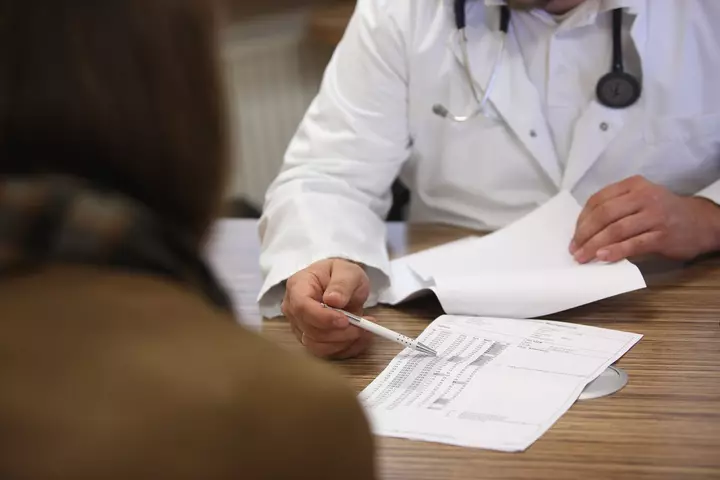
One in three patients will receive the wrong diagnosis firsthand, according to the Agency for Healthcare Research and Quality (AHRQ). Research cited by the agency suggests that 79 percent of diagnostic errors are related to the patient-clinician encounter, with up to 56 percent associated with miscommunication during that encounter. Research has also found that patients can be interrupted by physicians 11 seconds after beginning to describe their concerns.
These figures highlight a fundamental challenge in modern medicine: when healthcare becomes increasingly focused on speed, efficiency, and processing more patients, the conversations that help physicians understand those patients can be cut short. The consequences can extend beyond a frustrating appointment to missed information, delayed diagnoses, and treatment decisions that fail to account for what matters most to the individual. In modern healthcare, it is remarkably easy for a human being to be reduced to a number.
A patient becomes a chart, a diagnosis, an MRI result, a procedure scheduled for Thursday morning, or the next name on an increasingly crowded clinic schedule. But to the person sitting in the examination room, the issue is rarely routine. It may determine whether that person can continue working, exercise again, sleep without pain, care for a spouse, travel, wear a normal shoe, or simply return to the life he or she once took for granted.
That distinction matters. After more than three decades in private practice, I have become convinced that one of medicine’s greatest challenges is not simply developing better treatments. It is making sure we do not lose the individual patient while creating a healthcare system designed for greater efficiency.
Physicians work in an environment of packed schedules, documentation requirements, insurance restrictions, administrative demands, and increasing pressure to see more patients in less time. Technology has also transformed medicine, often for the better. We have access to extraordinary imaging, electronic records, sophisticated diagnostic tools, and now artificial intelligence.
But medicine cannot become so efficient that listening becomes inefficient. Two patients can walk into a physician's office with exactly the same diagnosis and need very different things. Their anatomy may be different.
Extract — continue reading at the source.