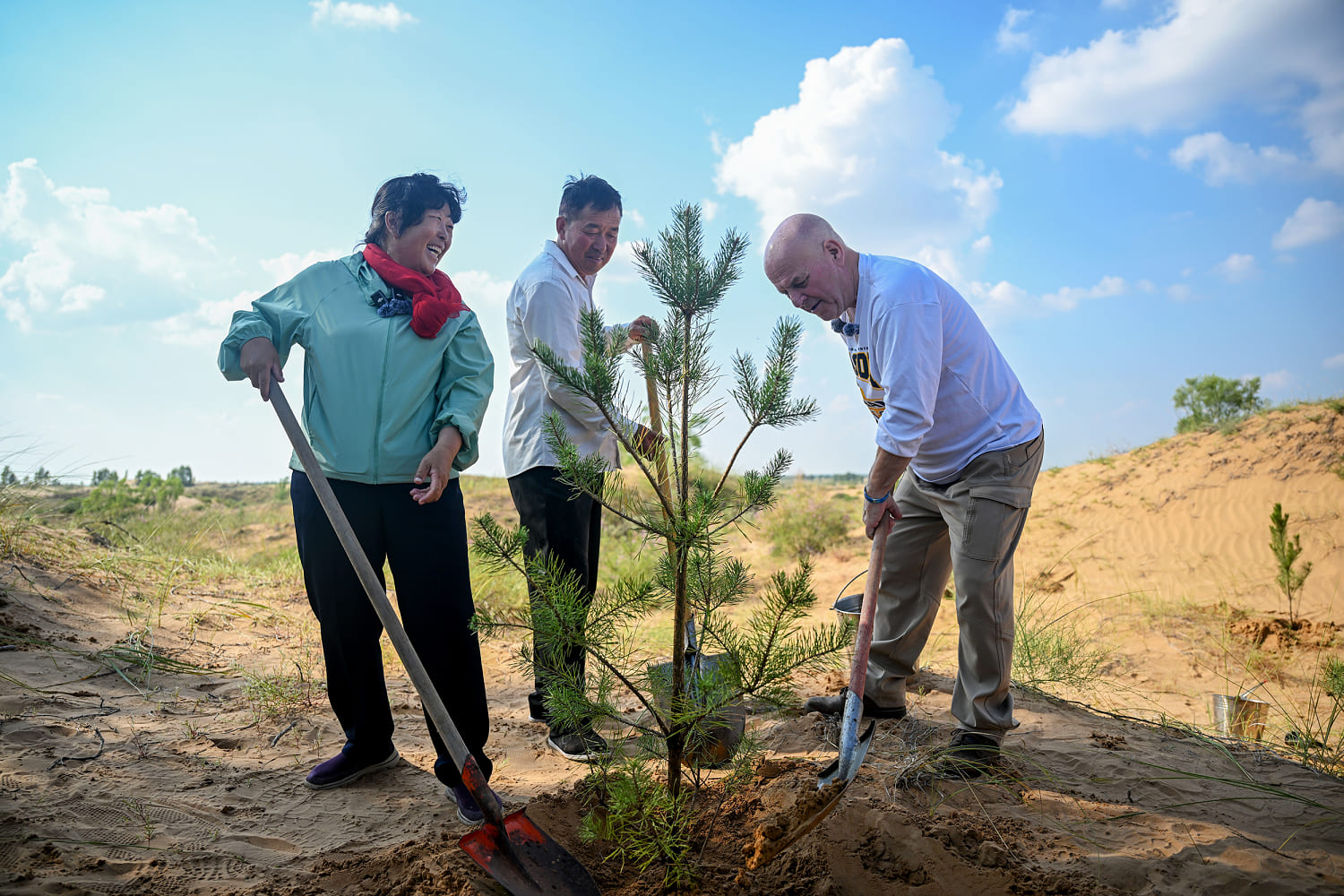
HONG KONG — Ronald Sakolsky never thought his money would go this far. What was once a vast, dry desert in northern China has transformed into a lush, green forest of 50,000 full-grown trees, thanks in part to a $5,000 donation he made more than a quarter century ago to a local farmer and “sand-control worker” named Yin Yuzhen. Sakolsky, 69, a retired teacher from Pennsylvania, was amazed to see the transformation in China’s Inner Mongolia region last month when he visited for the first time in 26 years.
Chinese leader Xi Jinping, in Washington this week for a summit with President Donald Trump, mentioned Sakolsky’s story in his toast at a state dinner on Thursday, saying it “touches the hearts of many Chinese people and stands as a shining example of the friendly exchanges between our two peoples.” Sakolsky was teaching English on exchange in China’s central Henan province in 1999 when he saw a TV news report about Yin. More than a decade earlier, the newly married Yin had started planting trees as a way to feel less isolated in her new home in the Mu Us Desert, also known as the Maowusu Desert (“bad water” in Mongolian). Moved by her story, Sakolsky raised $5,000, which was many times Yin’s annual income, so she could plant even more.
They met in person in 2000, when Yin promised Sakolsky that she and her family would take good care of the saplings. Earlier this year, Yin launched an online campaign to track down Sakolsky, and last month he made a 10-day visit to China that included an emotional reunion with Yin in her forest, where the trees now stand more than 30 feet high and the government has named a grove after him. The two of them planted a friendship tree, and Sakolsky collected a jar of sand to take home to Pennsylvania.
Yin also gave him a cross-stitch with the words “One Earth, One Dream.” “I want him to know that I kept my word, and that Chinese people keep our promises,” she said. Yin called Sakolsky her “brother” and said the sapling they planted together would be standing tall in another 26 years. Reports on Sakolsky’s visit have been heavily promoted by Chinese authorities and widely viewed on Chinese social media, where commenters described him as “a real friend of Chinese people.” Tree-planting efforts are part of a decadeslong government campaign sometimes referred to as China’s “Great Green Wall,” which was launched in 1978 as a 73-year effort intended to reduce sandstorms and help stave off desertification associated with global climate change.
Away from emotional stories like Yin’s, the campaign has had mixed success. While the Great Green Wall is a “great initiative in principle,” the Chinese government tends to emphasize “top-down, technocratic solutions to environmental problems” and focus on targets more than quality, said Judith Shapiro, who teaches at American University in the department of environment, development and health. The loss of open land for nomadic herding as a result of the initiative “remains a serious blow to some ethnic minority nationalities,” she said.
In the program’s early years, deserts were lined with “fast-growing but water-hungry” trees such as poplars that depleted water tables, though more suitable and biodiverse species are now being planted. Days after Sakolsky met with Yin in China’s arid north, a likely impact of the changing climate was felt when a devastating flood struck 2,000 miles away along the Nepal-China border. More than 1,400 people have been confirmed dead and thousands remain missing across Nepal and China’s Tibet region after the Aug. 26 disaster, which experts say was linked to warming temperatures in the Himalayas.
Extract — continue reading at the source.