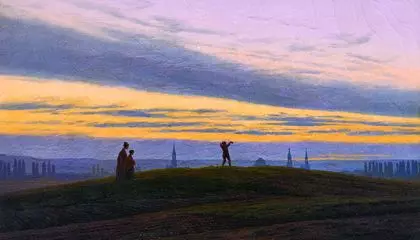
My mission was to go to New York’s Metropolitan Museum of Art and get close to The Evening Star by the German Romantic painter Caspar David Friedrich. The Evening Star—a nickname for Venus—joined several works not previously displayed in the United States, part of a Friedrich exhibition called “The Soul of Nature,” honoring the 250th anniversary of the artist’s birth. According to the museum’s description, Venus could be seen as “a tiny bright dot” barely visible above a cloud bank.
In the painting, three figures stand on a hill outside Dresden, Germany, at sunset. A young boy at center, his back to the viewer, lifts his arms in exultation. The work’s title character seemed to be missing from prints and art books depicting The Evening Star.
As a caver, I’m normally trying to solve mysteries deep in the earth. This unaccustomed aboveground task came to me, indirectly, from Don Olson, the astronomer and astrophysicist. In 2024, I’d casually met one of his research collaborators, Ava Pope, through her partner, Mike Newsome, both fellow caving enthusiasts. (The two often sponsored caver gatherings at their Virginia farm.) When Pope saw on social media that my wife, Kathy, and I were in New York for the weekend, she texted me.
The exhibition would end in less than two months, and she explained that if I could find and photograph Venus, my images might help Olson unravel several mysteries: From what physical spot did Friedrich observe the scene? And who, for that matter, is the family depicted in the scene? I was determined to find out.
As I would learn, Olson and his students and collaborators have taken on a singular approach, finding new truths in paintings we thought we knew. Olson began using astronomy to investigate creative works in the 1980s at Texas State University, when an English professor asked him for help understanding complex astronomical passages in “The Franklin’s Tale,” one of Chaucer’s Canterbury Tales. His astronomical research connected an abnormally high tide on the coast of Brittany—a major plot device in the story—to an extreme flood on December 19, 1340, which may have inspired the incident in Chaucer.
Besides co-writing a paper about the various lines of evidence that led him to that date, Olson studied astronomical elements in a variety of other works: Claude Monet’s The Cliff, Étretat, Sunset (pinpointing the beach location where the artist stood); Vincent van Gogh’s White House at Night (the golden disk in the sky must be Venus around a sunset in June 1890, as opposed to sunrise, moonrise or moonset); Ansel Adams’ Autumn Moon (the remote and never-before-identified Yosemite location from which the photograph must have been taken); William Shakespeare’s Hamlet (whether the star in the opening scene is a planet, or Tycho’s supernova, or something else); Mary Shelley’s Frankenstein (verifying that the “waking dream” she later described as inspiring her story happened on a moonlit evening in Switzerland on June 16, 1816); and historical events from ancient Rome (locating Julius Caesar’s first invasion of Britain) to World War II (explaining a disastrous tide for Marines landing at Tarawa in the Central Pacific). Olson realized that many dates and locations where artworks were made, even the very scenes they depicted, had been incorrectly reported in books and exhibitions, which often gave conflicting years and places. Olson felt certain these were errors he could fix by combining astronomical data with site visits and deep dives into historical records.
Extract — continue reading at the source.