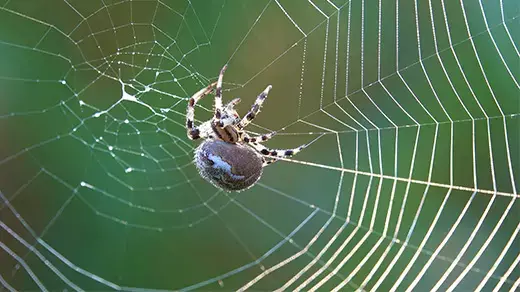
Within milliseconds, it spins a soup of proteins into sturdy climbing gear. Using a thin, shimmering strand of silk, the spider hauls itself back up. The strand is tougher than Kevlar, the synthetic fiber in bike tires and bulletproof vests, and stronger than steel.
It’s flexible and biocompatible with human bodies. Scientists dream of making spider silk into high-performing materials for seat belts, helmets, naval materials, and even scaffolds to help repair brain cells. But attempts to make spider silk in the lab have fallen short because researchers don’t know enough about how a spider spins “silk dope,” a liquid blend of proteins, water, and salt, from its silk glands into a remarkable solid.
Mapping out the molecular mechanisms behind the process is “really the holy grail” for the field, said Gregory Holland, a chemist and spectroscopist at San Diego State University. Recently, he led research that described how the molecules in liquid spider dope reorganize into semiliquid droplets called condensates before turning into solid silk fiber. The result is an atomic-level look into the spider’s silk factory.
The findings are also a practical guide to the formation of condensates, which nature has used repeatedly to organize molecules for genetic processes and for the creation of impressively strong biological materials. By unpacking how nature uses condensates, scientists hope to re-create some of its most rugged materials. Spiders are incredible natural factories.
They can spin up to seven types of silks, and the same spider can often spin several of them. Aciniform silk wraps up insects for later snacking. Rubbery flagelliform silk reinforces the capture spiral to absorb shock.
Dragline silk anchors webs and spiders to walls. Each type of silk has different properties depending on the species and related to how its molecules are assembled. And silks of the same type can have slightly different properties depending on the species.
Extract — continue reading at the source.