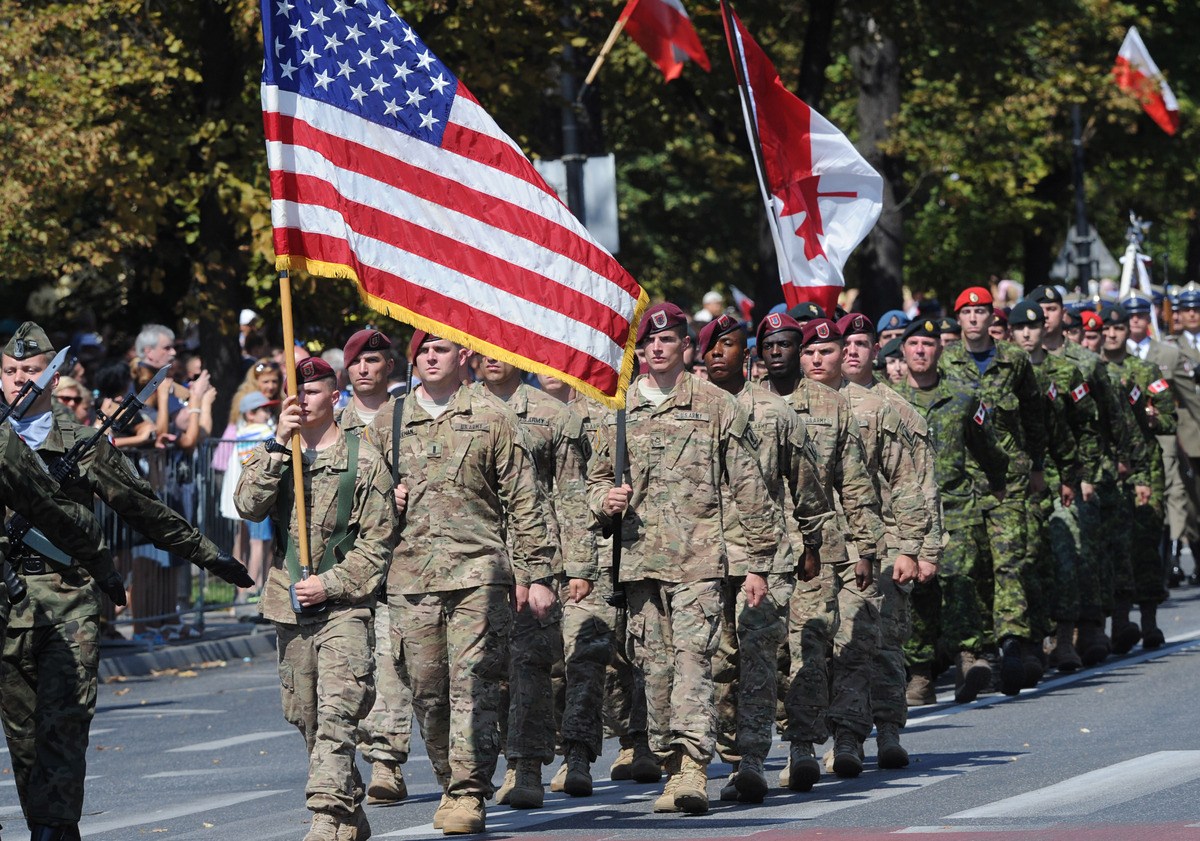
Canada's prime minister, Mark Carney, said Ottawa has examined the possibility of a U.S. military attack on Washington's northern neighbor after President Donald Trump repeatedly referred to Canada as the U.S.'s 51st state. Trump has stewarded U.S.-Canadian relations to one of their worst ebbs in modern history, embroiling the two nations in a tumultuous trade war while Ottawa sidled closer to its European friends in NATO. The Trump administration's frequent christening of Canada as the U.S.'s 51st state has been sharply criticized by Ottawa, as concerns over whether the U.S. would launch military action against fellow NATO member Denmark for control of Greenland forced American allies to re-evaluate whether the U.S. could turn its military might on them—a previously unfathomable prospect.
Carney, who has a strained relationship with Trump since sweeping to power on the back of anti-U.S. sentiment in March 2025, said during an interview with the New York Times he had prepared for the "extreme tail risk" the Trump administration could greenlight military action against Canada. It would "be irresponsible not to," the Canadian leader added in the interview published on Wednesday. Military planners are expected to prepare for a whole range of scenarios, including events they deem almost impossible or extremely unlikely.
In 1930, U.S. military strategists devised War Plan Red, which plotted targets in Canada the U.S. could strike during a hypothetical conflict with the U.K. Then, in January this year, the Globe and Mail, a Canadian newspaper, reported the Canadian military had modeled a U.S. invasion of Canada—and how Ottawa would respond—for the first time in a century. The Canadian military is closely enmeshed with the U.S. armed forces.
Canada operates American-made equipment, while Ottawa and Washington are both part of the Five Eyes intelligence network for information sharing. The two bordering countries even have a binational command: The North American Aerospace Defense Command (NORAD). Among its responsibilities, NORAD is tasked with making sure no long-range ballistic missiles from countries like Russia can reach North America.
But the U.S. military dwarfs Canada's. While the U.S. aims to make its presence felt across the world with its vast footprint, Canada's armed forces are geared more toward defending Canadian territory and contributing to NATO missions. The U.S. is the world's largest military spender, and the White House has asked Congress to boost this further to reach $1.5 trillion in defense expenditure for the 2027 fiscal year—a further surge of nearly 50 percent.
Canada, meanwhile, has been criticized by the U.S. for its low defense spending and an overreliance on U.S. forces, as have many European members of NATO. NATO nations, including Canada, committed last year to dedicate 5 percent of their gross domestic product (GDP) to defense by 2035 after sustained pressure to surge military spending from the U.S. Carney said in May Canada expected to spend 4 percent of its GDP on defense by the end of this decade.
Extract — continue reading at the source.