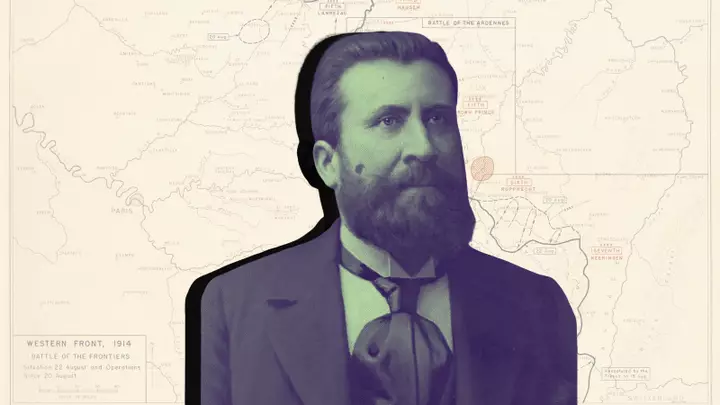
On the evening of July 31, 1914, after their fruitless visit to the foreign ministry to argue for French neutrality in the coming war, Jean Jaurès and Jean Longuet (the grandson of Karl Marx) travelled by taxi to the offices of the party newspaper, L’Humanité, where the socialist leader made notes for his editorial for the next day, a last appeal for peace, before leaving with a few colleagues to dine at the nearby Café du Croissant on rue Montmartre. It was a stiflingly hot evening and Jaurès sat with his back to a drawn curtain, beside an open window. At about 9.15 a young man, Raoul Villain, fired two revolver shots at him from the street.
Jaurès died almost instantly. Villain, twenty eight years old, the son of a court clerk from Reims, a quiet and polite young man according to all who knew him, but unsettled and apparently directionless in life, had been a member of the Christian social movement Le Sillon (The Furrow) until it was condemned by Pope Pius X in 1910. Later he joined the League of Young Friends of Alsace-Lorraine, a campaigning group sponsored by various right-wing politicians, including Maurice Barrès, that propagandised, chiefly among students, over the “lost provinces” of Alsace and Moselle and prepared them psychologically for the challenge of a new war with Germany.
The dramatic principle formulated by Anton Chekhov that if in a play a pistol should make an appearance in the first act it will be used in a subsequent one (“Chekhov’s gun”) has perhaps a certain relevance when applied to the habitual rhetoric of French nationalism. If the idea that murdering a political opponent can be seen as a patriotic act is repeatedly broadcast, it is probably just a matter of time before someone decides to translate it into reality. It would have been impossible for an avid reader of the nationalist press like Villain to have been unaware of the frequent accusations of treason against Jaurès and the repeated calls for him to be eliminated.
For many years, but particularly since his campaign in 1913 against the extension of the length of compulsory military service to three years, he had been a particular target, and not just for the usual suspects: his former Dreyfusard ally Charles Péguy, an ardent spirit once a socialist but in the 1900s converted to nationalism and Catholicism, had also subjected him to intemperate attack. War is above all, in their eyes, the occasion to demonstrate the most noble human virtues…energy, self-mastery, sacrifice to a cause that is greater than oneself. For Charles Maurras matters were, as always, eminently simple: “Jaurès is Germany.” His colleague “Critias,” writing in the newspaper L’Action française, went a little further: “We wouldn’t want to suggest that anyone should resort to political assassination.
Jaurès should be seized with trembling,” since it was possible that some zealot, after reading his articles in L’Humanité, might be tempted to seek to “resolve by the experimental method” the question of whether firing a revolver at him would produce the same effect as it did on Gaston Calmette. The editor of Paris-Midi offered the view that a general who assembled a firing squad to “put some lead at point blank range into Citizen Jaurès’s brain” would be doing no more than his duty. Jaurès’s pacifism was in fact far from absolute, let alone a policy verging on treason.
He had always made it clear that while he would do everything within his power to prevent war, if he was unsuccessful in his efforts and France was invaded he would urge socialists to defend their country. This position was endorsed by the trade unions and even the small, traditionally anti-militarist far-left faction of the socialist party led by Gustave Hervé. Over the preceding decades successive governments had assembled a list of potential “subversives” who in an emergency could be interned to prevent them resisting mobilisation for war.
Extract — continue reading at the source.