In the early 1960s, when Peter Zumthor was a teenage apprentice in his father’s cabinet-making workshop, he designed his first cupboard. He later recalled the satisfaction of fitting the door so perfectly that it closed “with a special sucking sound”, saying his father instilled in him “the Basel pride in the well-built object”. Six decades on, with a fleet of globally celebrated projects to his name, the 83-year-old Swiss architect is back in Basel, beaming with the same local pride.
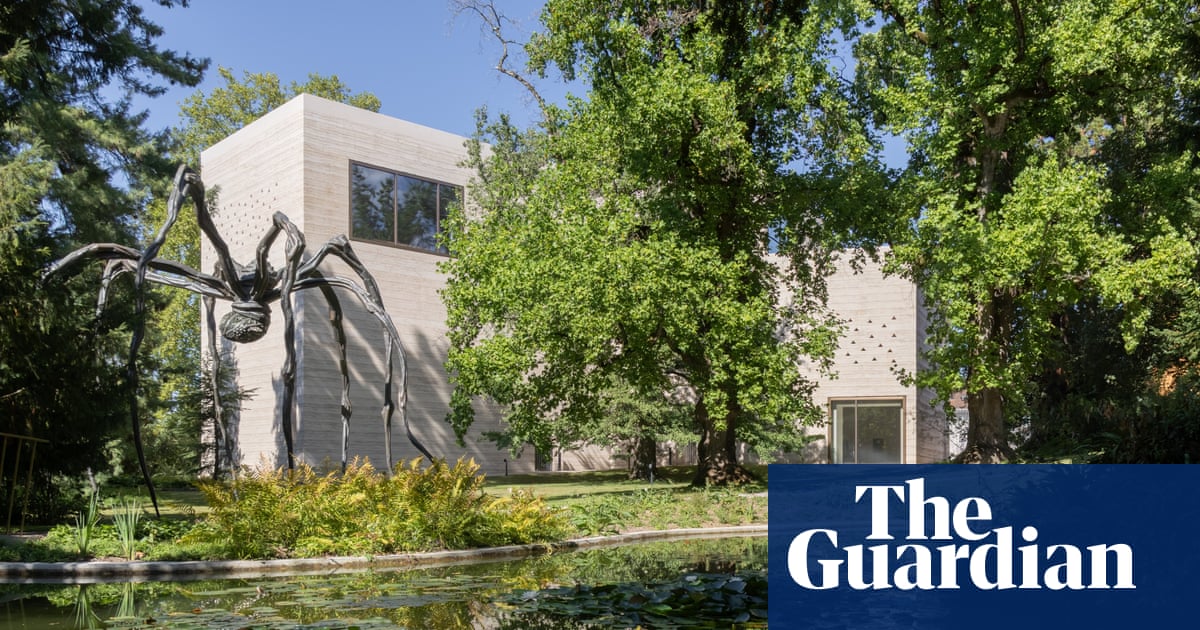
He is gazing out at his latest well-built object, which is also his first project here: a monolithic new gallery that looks chiselled from the earth, its layers of pale crumbly concrete hammered into shape, its big oak and bronze doors – their handles wrapped with leather cord – closing with that same satisfyingly expensive Swiss swoosh. They weren’t surprised if something had to be custom-made.” It was quite a change from his previous building site. Fresh from the recent opening of the tortuous, two-decade-long, $724m addition to the Los Angeles County Museum of Art, Zumthor is visibly relieved to be back on home turf.
From the pear wood handrails to the leather benches and blown glass lamps, every piece of his new gallery has been meticulously handmade. But is the sum of these bespoke parts a worthy companion to one of the country’s – if not the world’s – most beloved art museums? Designed by Italian architect Renzo Piano, the Beyeler Foundation was hailed as a model of elegant restraint when it opened in October 1997 – the same month as Frank Gehry’s billowing Bilbao Guggenheim – praised as a sober foil to the “iconic” tendencies of the time.
Sited in Riehen, just outside Basel, in the grounds of an 18th-century villa, the museum was commissioned by Ernst Beyeler, Europe’s pre-eminent modern art dealer and co-founder of Art Basel, and his wife Hildy, to house their staggering collection of Monets and Mirós, Matisses and Picassos. A long, low, temple-like shed nestled in a garden, the foundation contains within its porphyry walls a luminous sequence of galleries, with daylight flooding through slender rooftop louvers. Piano took his hi-tech fetish and wrapped it in a luxurious stone skin, foreshadowing his bigger museums to come.
But it was too small right from the day it opened. Two years later, it was extended by 12 metres and soon became the most visited art museum in the country, receiving 500,000 visitors a year. The challenge was how to extend a museum already deemed perfect by its art world patrons.
It is the villa that this garden was missing.” The foundation acquired the Iselin-Weber park, a formerly private woodland adjacent to the museum campus, which now doubles its size, and where Zumthor’s gallery rises like a rocky outcrop. It is one of three new structures he has designed, along with a five-storey, timber-clad office and art-handling block, and an auditorium pavilion, conceived as an open public lounge – a particularly appealing space that can be accessed without a ticket. So we’ve turned it into a social space for people to come and hang out, read books, listen to podcasts or do some work, a real extension of the park.” The three buildings stand as an eclectic ensemble on either side of a lane, framing a public square of sorts, where a new drinking fountain trickles into a big stone trough, as in a traditional mountain village, welcoming art pilgrims to Zumthor-ville.
Extract — continue reading at the source.