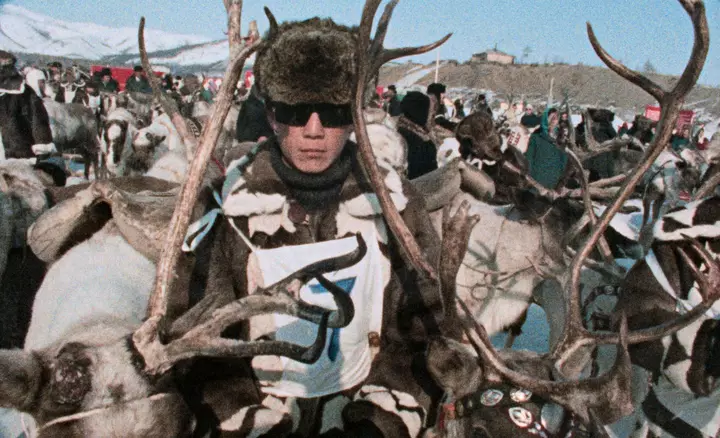
Journeying from Moscow to the Soviet Far East and then back west, this sprawling documentary shows a multicultural nation stubbornly resistant to Politburo attempts at homogeneity. In the early 1970s, Italian film crews spread out across the USSR, capturing a vast, multicultural empire few had ever seen in such diversity. From urban commuters to village fêtes, Baku trawlers to Siberian reindeer herders, the cameramen aimed to capture the Soviet polity at a time when Westerners had a gray, monolithic image of what lay behind the Iron Curtain.
Granted official permission, they managed to resist any push towards propaganda, even finding ways to slyly critique a system that proclaimed regional autonomy but controlled everything from the Kremlin. While planned as a monumental, multi-chapter TV series, only a few episodes wound up being broadcast on Italian TV, just once, following which the endeavor lay forgotten in the archives. If ever there was a project for Sergei Loznitsa, this was it.
In “Imperium,” working with 60 hours of 16mm, the master documentarian organizes this journey along geographic lines, starting in Moscow and heading east, then doubling back through “the Stans” and the Baltic republics until ending in what was then Leningrad. As with Loznitsa’s past films of this type, some snippets of conversation and music have been added, but otherwise the footage has simply been restored and edited together. What’s revealed is an immense state whose distinct regions still managed to hold onto unique traditions, notwithstanding an incessant centralized proclamation of unity.
While “Imperium” can be engrossing, its nearly three-hour running time is felt more than in Loznitsa masterpieces like “Maidan” and “State Funeral.” Perhaps that’s because in those films, one feels the force of history pushing us forward, inexorably heading to a watershed moment whose impact continues to resonate across the decades. With “Imperium,” the motivation is clear yet the concept is more diffuse. It’s also a film which will likely resonate best with those of us old enough to recall how the Soviet Union was discussed in the West at the time, a decade before Ronald Reagan’s “Evil Empire” remark — which simply gave a reductivist Star Wars moniker to the anti-communist propaganda suffusing American-driven global discourse since the end of the Second World War.
For Loznitsa, of course, his interest is inside the country rather than how it was perceived from abroad, though it will be impossible for most audiences to separate the two. The film kicks off with a classic parade in Red Square for the 24th Congress of the Central Committee of the Communist Party, with banners touting the same slogans from the previous forty years about production targets being met ahead of schedule. Next comes the GUM department store and window displays with tuxedos, shiny patent leather shoes and beaded handbags, making us wonder who in early 1970s Moscow was buying such luxury goods.
Commercialized religion makes its first appearance with a lively trade in Christmas decorations, one of many reminders that despite an official policy of atheism, certain traditions were allowed to persist. (Vladimir Putin, of course, has done an even better job in harnessing religion to his oligarchic dictatorship.) From the capital the footage moves east, where consumer goods are far more difficult to obtain. In Suzdal, an old woman washes clothes in an ice hole; shots of Vladimir show a town seemingly unchanged from pre-Revolutionary days; further south, residents come out for a winter carnival whose roots must date long before Leninism arrived. As the cameramen spread east, local customs become stronger: Bactrian camel races near the Mongolian border, reindeer sleds in the Sakha Republic.
Extract — continue reading at the source.

.png)