In April, metal detectorists stumbled upon a massive cache of 1,000-year-old silver coins in eastern Norway. At the time, archaeologists were impressed by the sheer size of the find, known as the Mørstad hoard, which totals thousands of coins and counting. They hailed it as the largest Viking Age coin stash ever found in Norway.
Now, researchers are even more excited about the cache. While cataloging the hoard, they found an exceedingly rare silver coin minted during the reign of Olaf II Haraldsson, a Norwegian king who later became the patron saint of Norway. Anne Skogsfjord, an archaeologist with the University of Oslo’s Museum of Cultural History, was the one who discovered the coin.
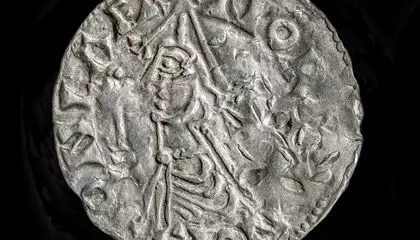
She didn’t realize its significance at first, until she took a closer look at the inscription: “ONLAF R+ NORMANORV,” which means “Olaf, King of the Norwegians,” according to a statement. She was shocked, as only four coins of that type had ever been found before, just one of which was discovered in Norway, during the restoration of church ruins in 1924. Fewer than 20 coins minted under Olaf have ever been found, and most have been discovered outside of Norway.
Jon Anders Risvaag, a numismatist at the Norwegian University of Science and Technology, agrees with that characterization, adding that finding an Olaf coin is like “finding a needle in a haystack,” he tells Science Norway’s Ida Irene Bergstrøm. The other side depicts a double cross and an inscription that means “My leader, my lord.” The design, researchers say, is emblematic of Olaf’s bid to establish Christianity in Norway. This is branding.” Only three types of coins were issued under Olaf’s reign, so the king and his inner circle were probably intimately involved in the design and production process.
Coin production in Norway didn’t really take off until Harald Hardrada came to power in 1045 C.E. For Olaf, minting coins was likely more of a political power move than anything else. It bears numerous small cuts that appear to have been made by a knife, which was a method of testing the silver content during transactions.
Researchers think the coin was probably produced around 1024 to 1028, near the end of the Viking Age, then buried with the rest of the Mørstad hoard in the late 1040s. During those intervening years, the cut marks suggest it changed hands several times. Olaf, born around 995, first discovered Christianity as a young man, when he joined Viking raids against England and France.
Extract — continue reading at the source.