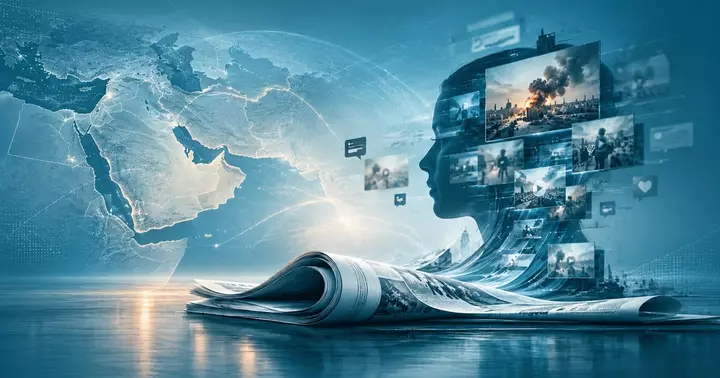
We live in an era where wars are fought not just on battlefields, but also on our screens, in our minds and through the narratives we are led to believe. Narratives are influencing perception while missiles destroy infrastructure. What happens when the war for truth becomes more dangerous than the actual battle itself?
Who’s controlling the narrative? When wars end, the fighting over what they meant begins: who won, who was to blame and who can be trusted to keep the peace. These questions are settled less on the battlefield than on screens, in feeds and in group chats.
For a Middle East emerging from the war that began on February 28, that contest may decide whether any new security order holds. The region is now asking what comes after deterrence. That question brought policymakers, military leaders and researchers from the United States, Europe, Asia and the Gulf to the TRENDS 6th Annual Conference, held in Abu Dhabi and organized by TRENDS Global, in collaboration with its global offices.
The answer cannot be measured only in missiles and alliances. Information resilience should be treated as security infrastructure, planned and funded like air defense, not managed as public relations. The struggle over perception can now matter as much as events on the ground.
That is no longer hyperbole. In any crisis today, governments, media outlets, political movements and non-state groups compete in real time to define what is happening. Disinformation, coordinated propaganda and now content generated by artificial intelligence (AI) mean a false account can reach millions before an official one is drafted.
As former BBC correspondent Karen Allen put it at the conference, “Now in an instant, I’m able to influence millions of people,” and algorithm manipulation is what we are increasingly seeing. This year’s war showed how real that is. Within days of the first U.S.-Israeli strikes on Iran, an AI-generated video of Dubai’s Burj Khalifa on fire, with crowds fleeing, was viewed tens of millions of times, according to BBC Verify.
Extract — continue reading at the source.